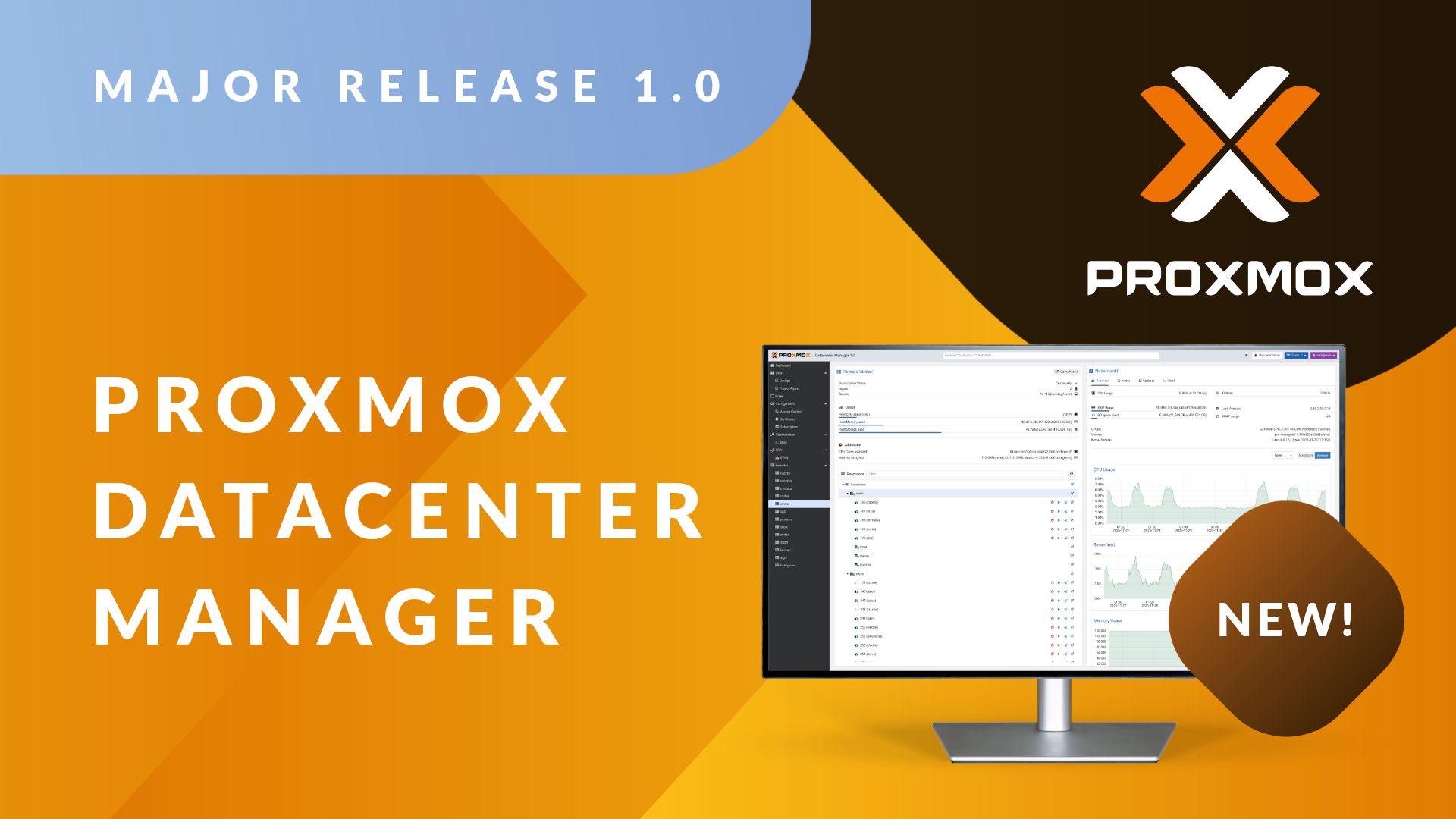
Proxmox has launched its secret weapon for enterprise-scale virtual infrastructure management: Proxmox Datacenter Manager 1.0. This first stable release revolutionizes how companies manage multiple Proxmox VE and Proxmox Backup Server environments, offering a centralized control panel that allows managing thousands of virtual machines from a single interface. Completely developed in Rust, with a modern frontend and support for live migrations between clusters, this release marks a before and after in distributed virtual infrastructure management.
What is Proxmox Datacenter Manager and why is it revolutionary?
Proxmox Datacenter Manager (PDM) is an open-source centralized management solution designed to oversee and manage multiple independent Proxmox environments. Unlike traditional solutions that require accessing each cluster individually, PDM provides an aggregated view of all connected nodes and clusters, enabling management of complex and distributed infrastructures, from local installations to globally scaled data centers.
What makes PDM revolutionary is its ability to manage multiple clusters without requiring a shared cluster network. This means you can manage geographically distributed Proxmox infrastructures, in different data centers or even in different countries, from a single control point. For companies with distributed IT infrastructure, this is a paradigm shift.
Main features: what can PDM do?
🔧 Cutting-edge technology stack
Proxmox Datacenter Manager is completely developed in Rust, from the backend API server to CLI tools and a completely new frontend. This modern technology stack offers:
- ✓ Exceptional performance: Rust guarantees speed and memory safety without garbage collection
- ✓ Modern frontend: New widget toolkit developed by Proxmox with better UX, accessibility and compatibility
- ✓ Solid foundation: Debian 13.2 "Trixie", Linux kernel 6.17 and ZFS 2.3.4 included
🎯 Centralized multi-cluster management
PDM's star feature is its ability to manage multiple Proxmox VE and Proxmox Backup Server clusters as remotes. You can add any Proxmox host or cluster as a remote, and PDM will monitor them and provide basic management using only the API.
This means you can:
Manage workload lifecycle: Start, stop, reboot and migrate guests centrally
Manage workload lifecycle: Start, stop, reboot and migrate guests centrally
Cross-cluster live migration: Balance load and perform maintenance without downtime, even between clusters without shared network
Cross-cluster live migration: Balance load and perform maintenance without downtime, even between clusters without shared network
Custom views: Create views filtered by remotes, resources, resource type or tags with dedicated access control
Custom views: Create views filtered by remotes, resources, resource type or tags with dedicated access control
Powerful search: Quickly find resources filtered by type, status or more criteria
Powerful search: Quickly find resources filtered by type, status or more criteria
📊 Centralized monitoring and metrics
PDM efficiently collects metrics from all your Proxmox remotes, providing a unified view of health, performance and capacity of your entire infrastructure. This includes:
- ✓ Centralized update view: See which systems need updates across your infrastructure
- ✓ Firewall and SDN status: Monitor network and security configuration from a single place
- ✓ Configuration health: Detect configuration issues before they affect production
🔐 Integrated enterprise security
PDM includes a robust enterprise access control system with support for:
Authentication: LDAP, Active Directory and OpenID Connect realms
API Tokens: For integration with external systems
Two-factor authentication (2FA): For enhanced security
Privilege management: Granular access control from the UI
Scalability: how much can PDM manage?
According to Proxmox, they have run tests with over 5000 remotes and over 10000 virtual guests to confirm the performance expectations of the new UI framework. Although there are still some pain points due to the early stage of development, they are confident they will be able to handle large setups with a moderate amount of resources.
This means PDM can scale from small businesses with a few clusters to large organizations with globally distributed infrastructure.
Requirements and compatibility
To use Proxmox Datacenter Manager, you need:
- Proxmox VE 8.4 or higher as minimum required version
- Proxmox Backup Server 3.4 or higher as minimum required version
- PDM must be able to connect directly to all Proxmox VE remotes to send API requests and query metrics
- Remotes do NOT need to connect to PDM directly (unidirectional connection)
⚠️ Important: Reverse proxies between PDM and Proxmox VE remotes are not supported. For hosts that must not be exposed directly to a non-private network, Proxmox recommends using tunneling (for example, WireGuard or OpenVPN).
SDN integration: EVPN between clusters
An especially interesting feature of PDM 1.0 is the initial Software-Defined Networking (SDN) integration with EVPN configuration between clusters. This allows creating virtual networks that extend between multiple clusters, facilitating workload migration and distributed network management.
Although this functionality is in its initial phase, it marks the path towards more advanced and centralized network management in future versions.
License and enterprise support
Proxmox Datacenter Manager is licensed under the GNU Affero General Public License v3 (GNU AGPLv3), which means it is completely open-source and you can use, modify and distribute it freely.
For companies that need enterprise support, Proxmox offers Enterprise Support available for existing customers with active Basic or higher subscriptions for their Proxmox remotes. This includes priority technical support and access to stable updates.
Use cases: who should use PDM?
Proxmox Datacenter Manager is ideal for:
- Companies with multiple data centers: Manage geographically distributed Proxmox infrastructure from a single panel
- Organizations with multiple clusters: Simplify management of multiple independent Proxmox environments
- IT teams that need centralized visibility: Monitor health, performance and capacity of entire infrastructure
- Companies that require cross-cluster migration: Balance load and perform maintenance without downtime
- Organizations seeking centralized network management: Leverage SDN integration with EVPN
Conclusion: the future of virtual infrastructure management
Proxmox Datacenter Manager 1.0 represents a qualitative leap in virtual infrastructure management. With its ability to manage multiple clusters without requiring shared networks, its modern technology stack and its focus on scalability, PDM is positioned to become the standard solution for companies managing Proxmox infrastructure at scale.
For companies already using Proxmox VE or Proxmox Backup Server, PDM offers a way to centralize management without sacrificing the flexibility of having multiple independent environments. The cross-cluster live migration capability, centralized monitoring and initial SDN integration make PDM a powerful tool for distributed infrastructures.
Although it is still in its first stable version, Proxmox's roadmap promises continuous improvements and new features. For companies looking to optimize their virtual infrastructure management, Proxmox Datacenter Manager 1.0 is definitely a solution to consider.
Need help with your Proxmox virtual infrastructure?
At everyWAN we help companies implement and manage scalable virtual infrastructure with Proxmox. From installation to optimization, our team of experts can help you get the most out of Proxmox Datacenter Manager and other enterprise virtualization solutions.
Contact everyWAN

 Microsoft 365
 ES
ES  CAT
CAT  EN
EN