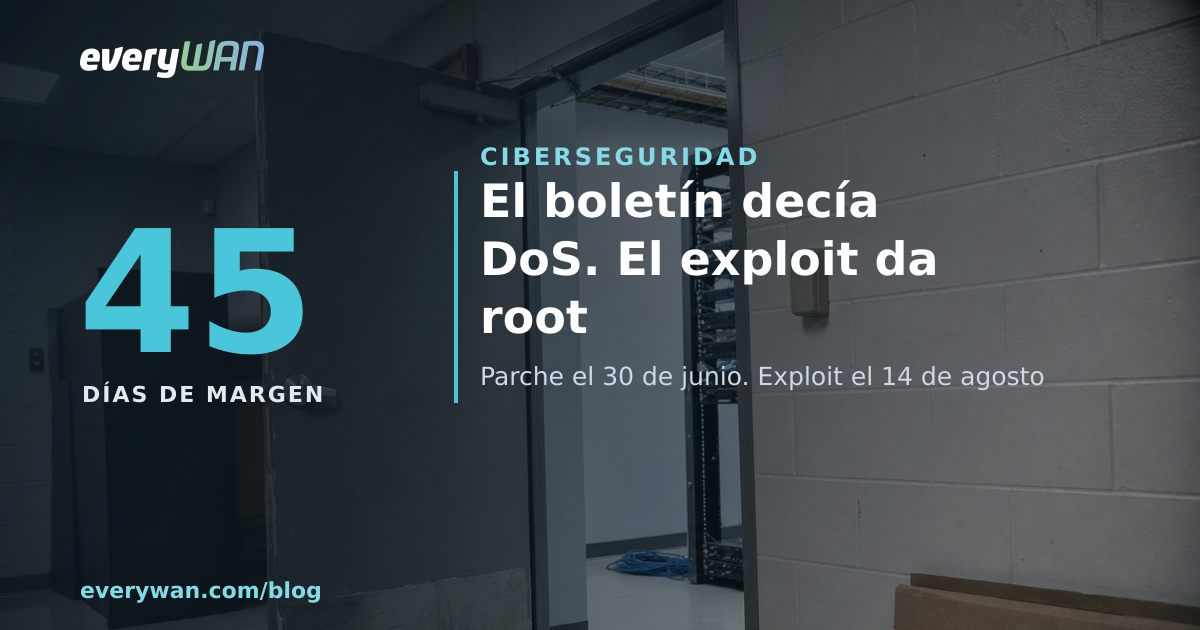
Three dates, and only one of them is yours. On 30 June Citrix shipped the patch for CVE-2026-8452 and described it as a denial of service. On 14 August, forty-five days later, researchers published the analysis and the code that turn that same bug into code execution as root, with no credentials. Attacks began soon afterwards and on 26 August CISA added it to its catalogue of exploited vulnerabilities with a 29 August deadline. Somebody else picked the first two dates. And the third. The only one you control is how long your maintenance window takes.
This was not a zero-day. The patch had been out for six weeks when the attacks started. Anyone who had applied it never noticed a thing; anyone who had filed it under "we will look at that after the summer" found out that the criterion that ordered the list had been written by the vendor's bulletin.
What the entry said, word for word
The official description, published on 30 June and still untouched, reads: "Memory overflow vulnerability NetScaler ADC and NetScaler Gateway leading to unpredictable or erroneous behavior and Denial of Service if the appliance is configured as a Gateway (SSL VPN, ICA Proxy, CVPN, RDP Proxy) or AAA virtual server". Memory overflow, erratic behaviour, denial of service. Nothing else.
And yet, on that same entry, two lines further down, sits the CVSS 4.0 vector scoring 8.8 with AV:N/AC:L/AT:N/PR:N/UI:N and — note this — VC:H. Network vector, low complexity, no privileges, no user interaction and high confidentiality impact. If the worst outcome were the appliance rebooting, confidentiality would not need to score high. It was there on the entry itself, in the field almost nobody reads, while the prose summary talked about something else.
That 8.8 was assigned by the vendor itself, which acts as CNA for its own vulnerabilities. The primary score, the one NIST signs, arrived much later: CVSS 3.1 of 9.8, CRITICAL, with high confidentiality, integrity and availability impact. The record shows as analysed and last modified on 27 August: one day after CISA catalogued it as exploited, and two weeks after the code to exploit it went public. The label was corrected once there were already web shells.
What it actually does: a prefix list that is too long
On 14 August, watchTowr published the full teardown. The bug lives in the code that canonicalises SAML signatures: while processing the <SignedInfo> element, the appliance copies the contents of the PrefixList attribute into a fixed-size global buffer "without checking whether it actually fits". Putting a long prefix list inside InclusiveNamespaces — something like N0 N1 N2 … N1999 — is enough to trample the header of the adjacent buffer.
From there the chain is textbook, which is exactly why it works so well: you overwrite the data pointer at offset +0x50 of that header, splitPktInner later uses that pointer for a memcpy, and a memcpy whose source and destination you control is arbitrary write. That gets used to overwrite the tx_pkt_complete_fptr function pointer and jump into your own code. The code runs inside nsppe, the packet engine, which runs as root. The researchers also set the SUID bit on /bin/sh to keep that privilege through the web shell.
The precondition for reachability, in the researchers' own words, is that "the Netscaler appliance is configured to use SAML as either a Service Provider (SP) or an Identity Provider (IdP)". Which is to say: the door opens in precisely the place where the appliance plays doorman. The component that validates who you are is the one that breaks on an unauthenticated request.
The 45 days you had
Forty-five days passed between the patch and the public exploit. That gap is about as close to a gift as this trade gets: the fix already existed, the map to exploit it did not. And it always gets wasted for the same reason, which is not laziness.
Upgrading the appliance that terminates your VPNs means, in practice, throwing everybody out. Sales lose their session, the published ERP cuts off, the night shift is locked out. That is why the edge device sits last in the patching queue: it is precisely the one you cannot reboot at eleven on a Tuesday morning. And that is why, when the bulletin says "denial of service" on top of it, the conversation ends before it starts — nobody schedules a night window, warns users and signs off a change in order to prevent a reboot.
The fix is not "patch faster", which is empty advice. It is accepting that the vendor's severity label scores the bug, not your exposure. A box that faces the internet, terminates sessions and validates identities cannot share a queue with the internal file server, whatever the label says. That kit deserves its own rule: a maintenance window agreed in advance, not negotiated every time.
How to tell whether you are patched without knocking the box over
The boring part first: the fixed versions are 14.1-72.61, 13.1-63.18 and 13.1-37.272 for the FIPS and NDcPP variants. If you are on 12.1 or 13.0 there is no patch to apply: Citrix will not release one for those branches, and what you have is not a patching task but a platform migration you are already late to plan.
The interesting part is how to confirm it from outside without firing the exploit at your own production, which is what nobody wants to do on a Thursday afternoon. Bishop Fox published a checker that uses size as an oracle: send a SAML request with a PrefixList of 513 bytes or more and read the response. "A patched build turns the request away at a size check before it reaches the rewrite step, while an unpatched build carries on and eventually returns a generic internal error". In practice: an unpatched appliance returns 500 Internal Server Error 43549; a patched one returns 200 Malformed Assertion sent to Netscaler. As a control you repeat with a short list — 35 bytes — to make sure the endpoint really is validating sizes rather than answering anything at all.
With two caveats worth saying out loud. First: you have to aim at the virtual server where the policy lives, and test every VIP — "Aim at the virtual server where the policy actually lives, and test each VIP" — because the VIP inventory of a mid-sized NetScaler rarely fits in anyone's head. Second, and more important: this tells you whether the fix is in place, not whether someone got in before you put it there. Two different questions, and the second one is the one that hurts.
The patch shuts the door; it does not evict whoever is already inside
That a patch does not evict whoever already got in has been said by half the industry since the first web shells. What we have not seen anywhere is the contradiction that appears when you put two official texts side by side. The vendor's remediation guide for this CVE says that "the remediation is a single-step process and you need to upgrade the vulnerable NetScaler instances to a release and build that has the fix". One step: upgrade. No mention of sessions, of credentials, or of checking whether the appliance had already been touched.
CISA's entry asks for something else. In the required-action field, on top of applying vendor mitigations, it demands compliance with directive BOD 26-04 and with the "Forensics Triage Requirements", and adds that each organisation is responsible for "evaluating each asset's internet exposure". Translated: the body that orders you to patch assumes patching is not enough, and asks for forensic triage in the same paragraph. Meanwhile the description on that very catalogue entry still reads, to this day, "which could lead to denial of service".
If your appliance sat exposed with SAML enabled and unpatched after 14 August, the upgrade is the first item on a list of four. What you look at, in this order:
- Files you did not put there. Previdian reported it the same day it started, with a "This morning we started seeing exploitation for CVE-2026-8452" and three IPs from three different countries: they dropped web shells with names as discreet as
x.phpandz.php, and ran reconnaissance commands likeidandecho. - SUID binaries. The published chain leaves the bit set on
/bin/sh. A SUID/bin/shon an appliance is an answer, not a question. - Everything the box knows. A NetScaler holds service credentials: the directory bind, certificates, policy secrets. With root inside, none of that is exclusively yours any more. Rotating it is the only item on this list that does not tolerate "next week".
- Live sessions. A session token issued before the patch still works after the patch. It is the same reasoning error we wrote about when somebody switched off the EDR with a reboot: you fix the mechanism and leave untouched the state the attacker already walked away with.
When this is not your problem
No NetScaler, no problem — and nobody needs to sell you urgency about a brand you do not own. With a NetScaler but no SAML configured as SP or IdP, the published chain does not reach you — although the vendor advisory also mentions Gateway configurations and AAA virtual servers, so the prudent line is to patch anyway and not argue the nuance with whoever is scanning you. And if the box publishes nothing to the internet, you have plenty of time: put it on the calendar for the next maintenance slot and forget about it until then.
On the size of the thing, the same honesty applies. The Shadowserver figures — over 22,000 NetScaler ADC and close to 1,800 Gateway instances facing the internet — we already looked at six days ago, when we wrote that on NetScaler your version does not tell you whether you are exposed, and the caveat is unchanged: they measure surface. Nobody has the count of compromised systems, because in there you have honeypots, already-patched boxes and configurations that never expose the vulnerable path. What has changed in those six days is that the code to get in is now public.
Yes, the same conclusion again
We are not going to pretend this is a new finding, not even for us. Yesterday we wrote that the Gitea bug "requires write access" and that the signup form hands that access over; the day before, that your identity provider is not an application, it is infrastructure. Three posts in one week with the same thing underneath: the entry describes the bug and you are the one who has to describe your installation. When something repeats like that it stops being news and becomes a property of the system; the property, here, is that the order of your patching queue is being written by another company's technical marketing department. And the description on this CVE is unchanged two months later, with the attacks already documented.
What we do with this
We do not sell Citrix licences, or anyone else's: we design, deploy and maintain infrastructure, which is why none of this is a product recommendation. Our work with an advisory like this is boring and has no trick to it. It starts with knowing what actually answers from outside — which is why we keep the network documented in NetBox as the source of truth rather than the purchase sheet — it continues by treating edge kit as its own case when deciding what hour it can be rebooted, and it ends, if the box was exposed, in credentials and sessions.
That is what sits behind our cybersecurity service and our managed EDR/MDR: not a pretty console, but someone who knows which of your boxes face the internet and who, when an advisory lands, has already decided what hour each one can be rebooted. If you do not have that list, start there; and if you have it but nobody reads it on Saturdays, that is what 24×7 support is for.
Sources (verified one by one): the official vulnerability description, publication date (30 June 2026), the vendor-as-CNA CVSS 4.0 vector of 8.8 with PR:N and VC:H, the NIST primary score of 9.8 CRITICAL in CVSS 3.1 and the record status (analysed, last modified 27 August 2026) — NVD, CVE-2026-8452; catalogue addition date (26 August), the 29 August deadline and the required-action text citing BOD 26-04 and the "Forensics Triage Requirements" — CISA KEV; technical analysis, the SAML SP/IdP precondition, root execution inside nsppe and the SUID bit on /bin/sh — watchTowr Labs, 14 August 2026; the size-oracle verification method (513 bytes, error 43549 versus "Malformed Assertion"), per-VIP testing and the absence of a patch for 12.1 and 13.0 — Bishop Fox; the vendor's "single-step" remediation — NetScaler Console documentation; the x.php and z.php web shells, reconnaissance commands and exploitation confirmed by Defused and Previdian — Help Net Security; the count of exposed appliances per Shadowserver — BleepingComputer. All consulted on 28 August 2026. The 45 days between patch and public exploit are our own subtraction over those dates. We did not run the Bishop Fox checker against anyone else's kit, and we do not suggest you do: you point it at your own, with written permission.
Do you know which of your boxes answer from the internet?
We go through which of your boxes answer from outside, cross them against open advisories and decide together which ones cannot wait for the next window. No alarmism, dates on the table.
Talk to everyWAN

 Microsoft 365
 ES
ES  CAT
CAT  EN
EN