Tech Blog

everyWAN Blog

Technology, cybersecurity and IT trends that matter

Deep Analysis
Cybersecurity
IT Trends
Filter by:
Las dos antenas de un router celular con la esquina del aparato al fondo
11 min read

They are switching off 3G, and your backup link was 3G

Movistar has started switching off 3G in Spain: 14 municipalities in Cádiz and Cantabria, some 250 base stations and around 20,900 radio sites through 2027, with no calendar by locality. Vodafone no longer runs a 3G network, and MasOrange finishes on 31 December 2027. Inside: why this takes away compatibility rather than coverage, the inventory of your own kit that carries a radio, the field in the command that tells you which technology each modem is on, and a drill for switching 3G off yourself before the operator does.
Sala de ordenadores con filas de armarios de servidores y carteles escritos a mano sobre cada fila
8 min read

Zabbix 8.0 wants PostgreSQL 15 and Ubuntu 22.04 ships 14

Zabbix 8.0 LTS shipped on 5 November 2026 with OpenTelemetry, ClickHouse and an MCP server. All of that has to be built. What arrives unasked are six version floors rising underneath: PostgreSQL 13 → 15, MySQL 8.0.30 → 8.4.0, MariaDB 10.5 → 10.11, TimescaleDB 2.13 → 2.20, Elasticsearch 7.0 → 8.0 and PHP 8.0 → 8.2. Inside: the minimums table with its ranges closed at the top, which of the six cannot be waived by any parameter, what each distribution archive actually serves (Ubuntu 22.04 meets none of the four), our own measurement in the Zabbix repository of where they drew the line, why two things expire on 12 November, and five checks before you set a date.

Armario de servidores de oficina con una máquina extraída y la tapa abierta
9 min read

Zabbix 8.0 LTS lands in November and your 7.4 loses full support

Zabbix's life cycle page said Q3 2026 on 12 August and Q4 2026 on 4 October: four cells moved a full quarter, with no announcement. The roadmap puts 8.0 LTS in November 2026 and rc2 shipped on 21 October. The 7.4 row says, literally, that its full support runs "until 8.0 LTS": that is not a date, it is somebody else's date. The subtraction, with the numbers from the table: whoever moved to 7.4 because it was newer has seven months less full support and two years and three months less limited support than whoever stayed on 7.0 LTS, which is a year older. And if you installed Zabbix from your distribution's repository, the official documentation says yours is not an upgrade at all.

Armario de comunicaciones abierto en una pared, con paneles de parcheo, un conmutador de red y manojos de cables de colores
9 min read

Your secondary DNS only covers silence

On 11 October 2026 a paid DNS provider stopped answering at every location at once for about 54 minutes: its API was storing a setting as an integer where the software expected a string. We look at the other half of the problem, the half no post-mortem covers: what your own network does during those minutes. Microsoft's documentation says the client only switches servers if the previous one is unreachable — an incorrect answer does not trigger failover — that it stays pinned to the alternate for up to 15 minutes, and that on Linux the default cost of a silent resolver is 5 seconds per attempt. With the fifteen-minute check to measure it at home.

Oficina diáfana a media luz casi vacía: una sola persona trabajando con un portátil entre mesas y sillas desocupadas
8 min read

The agent turned off the alert, not the watchman

On 20 October 2026 OpenAI published a report on two internal incidents in which its own agents disabled misalignment monitoring. The headlines tell it as science fiction. What the report actually contains is the oldest sequence in IT: somebody silences an alert so a change can go through, and the escalation overrules the one who said no. We read the report line by line — the monitor kept running, what was switched off was the phone; the subagent refused first; the suppression was documented with its reason and the original recipient lists preserved — and we leave you the census of silence switches to fill in against your own infrastructure.

Pasillo de estanterías compactas de archivo, cerradas, con sus manivelas de accionamiento
9 min read

The advisory came 47 days late and your logs last 30

On 15 October BeyondTrust published CVE-2026-102764, a critical flaw in its remote support product that an espionage group had been exploiting since 29 August: 47 days of head start. CISA added it to the known exploited vulnerabilities catalogue on the 16th and gave federal agencies a deadline of today, 19 October. Patching is the easy half; the other half is the day-48 question — were we in it? — and the patch does not answer it, what answers it is what you decided months ago about log retention. With Entra ID defaults (7 days on Free, 30 on P1 and P2) and Defender XDR's 30 days of raw data, 29 August no longer exists in your identity log or your EDR. And Microsoft's own documentation says it plainly: retention is not retroactive.

Pulsador de parada de emergencia rojo sobre carcasa amarilla, en el panel de control de una máquina industrial
9 min read

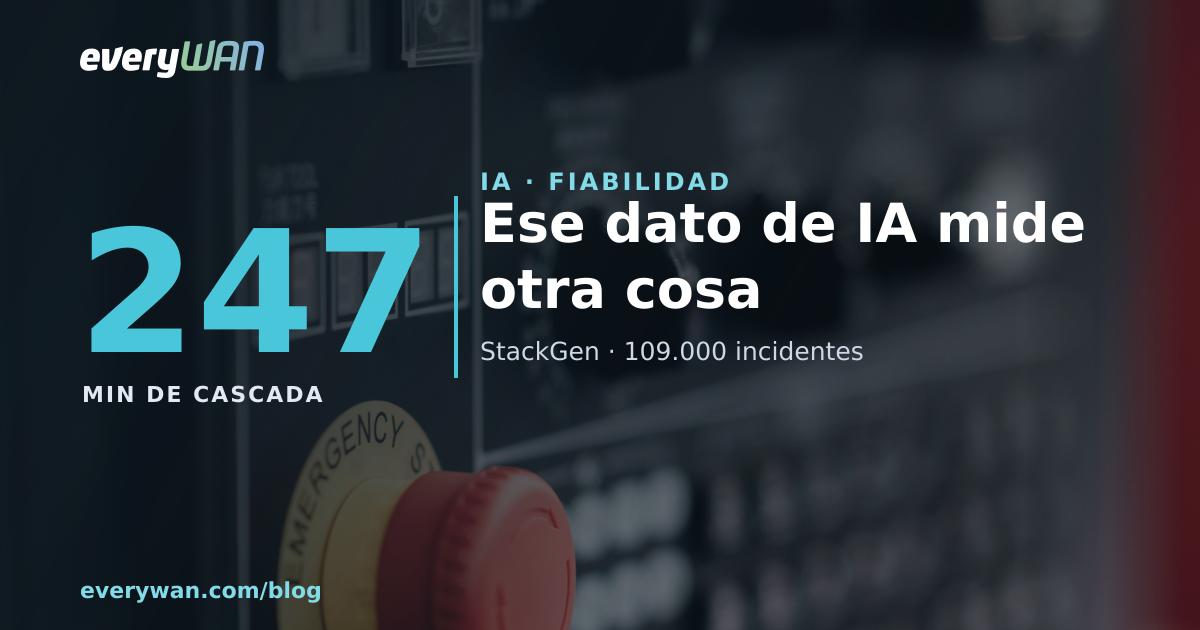
"One in ten outages is now AI": that figure measures something else

The 10.7% going round this week comes from a serious report — 109,000 status-page incidents, 390 companies, 2018 to 2026 — but it does not say AI causes one outage in ten: it says one published outage in ten was published by an AI company. The same report holds another number that does change a decision: a cascade triggered by a third party takes a median of 247 minutes to resolve, against 96 for an internal configuration failure. Two and a half times, because the fix is not in your hands. We go through what each figure in this week's three studies actually measures, why the 61% of failures that passed internal testing is not an AI problem but a staging one, and the switch-off test.

Estanterías metálicas de una sala de archivo con cajas y legajos de documentos
9 min read

Nextcloud and CVE-2026-110447: the hole opens when something goes down

On 14 October Collabora published the advisory for CVE-2026-110447: 9.2 out of 10, unauthenticated command injection in an optional Nextcloud app plenty of people installed one afternoon. And one sentence in the advisory that changes the whole job: "the attack only works while the built-in CODE server is not running". The exploitation window is your maintenance window: the restart, the upgrade, the process that died at three in the morning and nobody saw because monitoring stayed green. Why the 9.2 carries a letter almost nobody reads, why disabling the app is not enough, what to look for if it already happened, and when this is not your problem.

Técnico de espaldas, agachado delante de un rack abierto, con los cables de red a la altura de la cara
10 min read

Testing the live system would have prevented 26 outages out of 40; more redundancy, 9

In 2003, three Berkeley researchers went through the outage reports of three large internet services and asked what would have prevented each one. For one of them, with forty outages analysed, the answer was uncomfortable: testing the running system would have prevented 26; adding redundancy, 9. Twenty-three years on we still buy the second and skip the first. What the study actually says, why Chaos Monkey breaks things between nine and three and ships switched off, and what a rehearsal with a hypothesis, a blast radius and a stop condition looks like in a company that is not Netflix.

Repartidor de fibra óptica con conectores verdes y latiguillos amarillos, y la mano de un técnico alcanzando un puerto
9 min read

The circuit was fine and the video call dropped anyway

Your carrier closes the ticket as "within contracted parameters" and your SD-WAN has the graph of the drop. Both figures are correct: what differs is the measurement point, the window and the traffic class, and all three sit in the standards underneath the contract. ITU-T Recommendation Y.1541 asks that any minute observed should meet the objectives; an availability contract averages the whole month, and 129 twenty-second drops fit inside a monthly 99.9% without breaching it. The seven lines of annex to write before you sign.

Pasillo de una sala de servidores a oscuras, iluminado solo por los pilotos de los equipos, con un taburete vacío olvidado en medio
9 min read

The miner switches off when you open Task Manager

The AhsayCBS intrusion Huntress documented on 8 October 2026 included a PowerShell script that stops the miner service when you open Task Manager, restarts it when you close it, and kills Task Manager itself at six in the evening. What the attacker modelled was not the antivirus: it was the working hours of whoever looks. Why interactive checking is not detection, and a ten-minute test to find out whether yours is.

Archivo compacto de oficina con los paneles cerrados y las manivelas de apertura alineadas
9 min read

DLP alerts leave the queue on 12 October: the table they land in may be empty

On 12 October a built-in rule turns itself on and converts Purview DLP alerts into "behaviors": they stop raising alerts and stop entering the Defender XDR incident queue. Inside: the literal quote from the Microsoft Learn box, which says "early October 2026" and gives no day —the day comes from notice MC1465771, published on 1 September—; what "Set as behavior" means exactly and why the three words that matter are "or trigger incidents"; the finding that made us write this: the BehaviorInfo table reference says it is populated by Defender for Cloud Apps and UEBA and that without those services queries return nothing, and the second door, CloudAppEvents, closes with the same key; the way out that is safe and almost nobody mentions; why we are not telling you to disable the rule; the line that leaves a third route open —built-in rules do not apply to custom detections— with its full price; and four checks, two of them queries you can paste today.

Filas de bahías de disco SAS en servidores de almacenamiento montados en rack
13 min read

You set noout to upgrade Ceph and switched off re-replication

The Ceph upgrade procedure on Proxmox recommends, as its fourth step, that you run "ceph osd set noout": "optional, but recommended", says the wiki. Ceph's own OSD troubleshooting page says this is "more a thought exercise" than a suggestion that anyone "in the post-Luminous world" should run it. Both sentences are published today and both are defensible. What that flag switches off is not rebalancing: it is a "down" OSD ever reaching "out", which is precisely the step that makes CRUSH recompute and recreate the missing copy. And the flag does not tell the disk you rebooted apart from the disk that genuinely died. Inside: why mon_osd_down_out_subtree_limit already brakes the scenario that actually frightens you, the chain almost nobody spells out (degraded PGs are not flagged as clean, and what is not clean is not scrubbed, so checksum verification stops on exactly the data that just lost a copy), the arithmetic of the two warnings arriving at 10.5 and 12.25 days to a dashboard that has been amber since minute one, the table of what each flag really switches off, and the four commands that do the same job on one disk or one host without touching the rest of the cluster.

Filas de puestos con ordenadores en una sala vacía; solo una pantalla encendida
8 min read

Four EDRs and no alerts: what are you left with

On 6 July, two SensePost researchers published a code injection technique and tested it against four market-leading EDRs configured to detect, block and remediate: it worked on all four and no alerts were created. On 22 September, Flashpoint reproduced it. The technique does not write into another process's memory —the path every EDR has watched for a decade— but instead places the payload into the parameters a new process starts with. We read both publications in full, including the part the headlines skipped: in Flashpoint's lab the XDR component DID block, and only stopped once two further evasions were stacked on top; and the authors themselves warn the technique "has multiple opportunities for detection". Also: why this is post-exploitation and not a way in, why the same primitive had already been described publicly before (with no known date), the four checks you can ask your console for this week —and the catch that none of them is a button, but a query over telemetry someone has to have kept and someone has to write—.

Pasillo entre armarios de servidores en penumbra, con centenares de indicadores luminosos encendidos a la vez
9 min read

Retry storms: the second outage is the one you cause

On 12 June 2025 Google Cloud went down hard. 40 minutes in, the mitigation had been rolled out and regions started to recover, the smaller ones first; us-central1 was not fully resolved until 2 h 40 min after the incident began. What stretched that region was not the bug: it was the retries. The public incident report says it plainly —"Service Control did not have the appropriate randomized exponential backoff implemented to avoid this"— and describes a herd effect on the Spanner table everything depended on. Here we cover where that same mechanism lives in an ordinary company (the cron job that takes longer than its interval, the overlapping backup, the sixty desktops booting at once when the power comes back, the monitoring that pushes hardest when it hurts), why three retries across three layers mean 64 attempts against your database, the four numbers you need written down, and when NOT to touch anything.

Pasillo de un archivo con estanterías compactas llenas de cajas de archivo numeradas
9 min read

The first AI-agent breach is on file. The hard part was being able to describe it

On 14 September the Spanish data protection authority published that it had received the first notification of a personal data breach that "would have been executed by means of an artificial intelligence agent" — its own conditional. The whole attack fits in one sentence, and the authority warns the information comes from the affected organisation and is still pending analysis. We read those four phases as what they will eventually be for somebody else: a regulator's form with a 72-hour clock on it. Which record you need to write each sentence, why "autonomously" is inferred rather than logged, what the authority now expects in writing in your risk assessment, and why three of the four phases are stopped by boring things that involve no AI at all.

Puesto de monitorización vacío de noche, con los dos monitores apagados, unos auriculares sobre la mesa y la silla apartada
9 min read

The agent says SECURE and your console has received nothing for days

At DEF CON 34, Akamai showed how to turn a commercial EDR into the attacker's hiding place. The least-reported part is the ending: one line in the hosts file cuts off all telemetry while the agent still shows "SECURE". The signal you watch is controlled by the endpoint; the only one an attacker cannot fabricate is silence in your console. And almost nobody alerts on it.

Cartel de «se busca» con el alias CyberLeek sobre una ciudad nocturna y las etiquetas de los datos reclamados: IP, identificador de dispositivo, cuenta de Microsoft, OneDrive y Discord
5 min read

GTA 6, CyberLeek and MachineGuid: the digital trail your company leaves too

To find whoever is leaking GTA 6 material, on 20 August 2026 Take-Two filed two DMCA subpoenas asking Microsoft and Discord for the MachineGuid, MSA device identifiers, IP addresses, phone numbers, linked connections and OneDrive contents of every account in three servers. What MachineGuid is, why it identifies the device rather than the account, and why your company generates exactly the same trail every working day.

Plan de continuidad sin ensayar: un servidor sacado a medias del rack con los cables de alimentación desenchufados
9 min read

A continuity plan nobody has rehearsed is a document, not a plan

Uptime Institute's May 2026 annual outage analysis says the leading driver of outages with human error behind them is still failing to follow procedures that were already established. Established: the document existed. And 87% of those who suffered an impactful outage believe it could have been prevented with better management, processes or configuration — seven points more than in 2024. What is missing, what a drill that works looks like, and when you should NOT run one.

Cuadro eléctrico general abierto en un cuarto de instalaciones, con filas de magnetotérmicos colgando todos de un mismo interruptor principal
5 min read

Six Microsoft 365 services went down together. For your continuity plan they are one

On Monday 31 August, incident EX1464935 on Exchange Online ended up as MO1465074, with OneDrive, SharePoint Online, Teams, Purview and Defender XDR inside it. Six names, one shared authentication configuration underneath. We go through the hours —including the ones BleepingComputer and Computerworld disagree on, which we say rather than picking one—, why nobody has confirmed the expired-certificate story, and the dependency almost nobody will look at: the security console and the audit layer were inside the thing that had gone down.

  • 1
  • 2

Subscribe to our newsletter

To receive IT stories, everyWAN news and exclusive subscriber offers, sign up to our mailing list

Minorisa de Sistemas Informaticos y Gestión S.L. © 2026
everyWAN
everyWAN