Tech Blog

everyWAN Blog

Technology, cybersecurity and IT trends that matter

Deep Analysis
Cybersecurity
IT Trends
Filter by:
Armario de comunicaciones con paneles de parcheo y centenares de latiguillos de red azules y grises sin etiquetar
8 min read

Puppet's patch does not revoke what your CA already signed

CISA added CVE-2026-115731 to the KEV on 17 November, with a 1 December deadline. Almost everybody quotes the first sentence of the entry: any client holding a CA-signed agent certificate can execute code on the Puppet Server. The second sentence is the one that sets your severity, and it is about whether your CA signs on its own. Inside: why the patch shuts the door without changing the lock, the three rungs of the response, and the one nobody has rehearsed.
Columna de servidores de rack idénticos, cada uno con su cable de red
9 min read

Same kernel, same nginx: one machine panics and the other does not, and the difference is in the NIC

NoisyTCP (CVE-2026-99288) has been in the Linux kernel for eleven years and takes a server down with no credentials at all. But having an affected kernel is not enough: TWO conditions are required, and the second one is how many receive queues your network card has. Inside: why a virtual machine panics in five seconds in the lab while tuned bare metal takes fourteen hours, why the kernel's own crash trace goes through virtnet_poll, why the 7.5 your scanner will show is contradicted by its own write-up, and the three ways out with what each one costs.

Macro del interior de un disco duro abierto: el plato y el brazo del cabezal
9 min read

CephX trusted the ticket it had just decrypted, and the fix has no CVE

Ceph v20.2.5 Tentacle, released on 2 November, carries a single security line: "CephX: hardened service ticket verification". It is the second half of the fix you rushed through in August with four CVEs breathing down your neck, and this half has no number, so it never enters a patch queue. Inside: the four checks the verifier no longer skips, why the 300-second tolerance says nothing about your NTP, the date each branch gets it (Squid gets it in its final release) and the ten-minute read-only audit.

Primer plano de una tarjeta gráfica de doble ventilador apoyada sobre una mesa
8 min read

The patch for your AI server shipped in June; the advisory, in November

On 9 November CISA added a GPUStack 9.8 to its catalogue of exploited vulnerabilities: no credentials, full administrator. The fix had been published since 18 June, and that release's notes —thirty-six listed fixes— never once say "authentication", "security" or "localhost". Inside: why the standard nginx recipe is enough to exploit it, what upgrading does not fix, why EPSS puts it below the median on the very same day, and the question nobody asks about your company's AI box.

Portátil abierto sobre una mesa de madera maciza, con el ratón al lado y la silla retirada
11 min read

Outlook leaks your hash, and Microsoft calls it "moderate"

Of the 1,095 vulnerabilities Microsoft patched on 10 November, exactly one is being exploited: CVE-2026-124194, in Outlook, carrying the lowest severity label in the batch. Inside: our own count against Microsoft's API, what its FAQ says word for word, why the Office patch does not arrive through Windows Update, the exact builds per channel, and the switch Windows 11 24H2 already ships to cut outbound NTLM (including when NOT to turn it on).

Armario de comunicaciones con bandejas de fibra, latiguillos amarillos y equipos de 1U apilados
9 min read

In 2023 patching the appliance was enough; the 2026 entry asks you to know how to switch it off

On 10 November CISA added two Barracuda flaws to the known exploited vulnerabilities catalog with a 13 November deadline: three days. The patch had been out since the 2nd. Inside: the chain in the catalog entry's own words (restoring a configuration backup without authenticating, and a timezone field that runs as root), the comparison with the entry for the same appliance 1,264 days earlier, why the deadline no longer measures severity —157 of the 295 entries added in 2026 carry three days— and the four questions you answer yourself, not the bulletin.

Teclado mecánico sobre un escritorio oscuro, el puesto desde el que se arranca un servidor MCP
7 min read

Pinning the MCP server version does not pin what runs

Corelight measured the MCP servers on one workstation over five weeks: it made no difference whether they were pinned to a release tag, an exact PyPI version or an exact Git commit; all of them drifted. One of the commit-pinned ones produced 17 distinct environments across 19 builds. Inside: the lab numbers, the 46% of public repositories that start an MCP server with no version, the official documentation that contradicts itself, the AgentScope CVE with two different scores, and the inventory we build ourselves.

Armario de comunicaciones de pared abierto, con un conmutador de 16 puertos y una maraña de cables dentro
9 min read

257 bytes open the account you took the password away from

On 5 November 2026 OpenSSH shipped 10.6p2 to close a bug that, by its own developers' account, is not theirs. The musl maintainer says it is not musl's either. Both are right, and a root shell fits between those two sentences. Inside: how three defensible decisions taken in 2012 and 2016 end up comparing an asterisk against an asterisk; why the exploitable accounts are precisely the ones you left key-only; why OpenWrt shows up on every list and is almost never affected; and the four concrete checks for this week.

Sala de máquinas pequeña: armarios con equipo encendido a la izquierda y, a la derecha, una mesa con un monitor apagado y un teclado
8 min read

A reboot won't recover the box that holds your backups

On 2 November 2026 Veeam shipped the kernel that fixes a 9.8-out-of-10 flaw in its backup appliances. Two days later it published an advisory on that same appliance recommending you disable automatic updates, because on certain AMD EPYC processors the boot stops with a kernel panic. Inside: what the "9" in the error message really says, read in the kernel source that boots the appliance; the line with an if that turns that failure into a halted machine; why the three processors on the list are really one single generation; why restarting the operating system does not recover the machine; and the four things we would check this week if your backups live inside a closed appliance.

Interior de una librería de cintas: paredes de cartuchos de copia a ambos lados del pasillo
9 min read

Restoring someone else's dump can create a root account

On 3 November 2026 MongoDB published four security advisories at once. None of the four is patched on the server: all of them close by moving Database Tools to 100.20.1, the package of binaries that lives on a technician's laptop, in the container image running the nightly backup and on the jump host. Inside: why excluding the admin namespace doesn't save you (the advisory says so), the four CVEs with their two contradictory scores, what the changelog tells you and the advisories don't, why your scanner will find nothing, why Ubuntu no longer ships the package, when this is NOT urgent, and the six-check inventory.

Aula de informática vacía con filas de ordenadores de sobremesa sobre las mesas
8 min read

Eight bytes and the driver is still signed

Someone generated over 2,500 copies of the same driver by changing eight bytes, and the signature stayed valid on every one. From there it has been repeated many times that this is how Windows' blocked-driver list got bypassed. We downloaded the list and counted it: none of its 1,702 hash rules blocks that file, and the rule that does block it does not look at the hash. Inside: why the same exclusion that keeps the signature valid keeps the hash Windows checks unchanged, which detection the trick really does defeat, why the 2013 registry value is not the answer — Microsoft's FAQ says so in one word — and what we are correcting from our own 6 October post.

Dos teléfonos móviles con la pantalla apagada sobre una mesa de madera clara en una terraza
9 min read

A zero-day in December, off-the-shelf ammunition in August

For one week in August 2026, opening a Ukrainian gas producer's website on an iPhone was enough: the attacker had injected code into an analytics service loaded by thousands of pages. Sekoia published the analysis on 4 November and none of the three chains used a zero-day. One of them is DarkSword, a commercial surveillance kit whose code had been sitting on GitHub for five months. We reconstruct the campaign through the age of each piece's patch and end where it hurts: the iOS branch the oldest chain targeted was still receiving updates 108 days before the attack.

Armario mural de comunicaciones abierto con un switch de sobremesa y una maraña de cables de red sin ordenar
9 min read

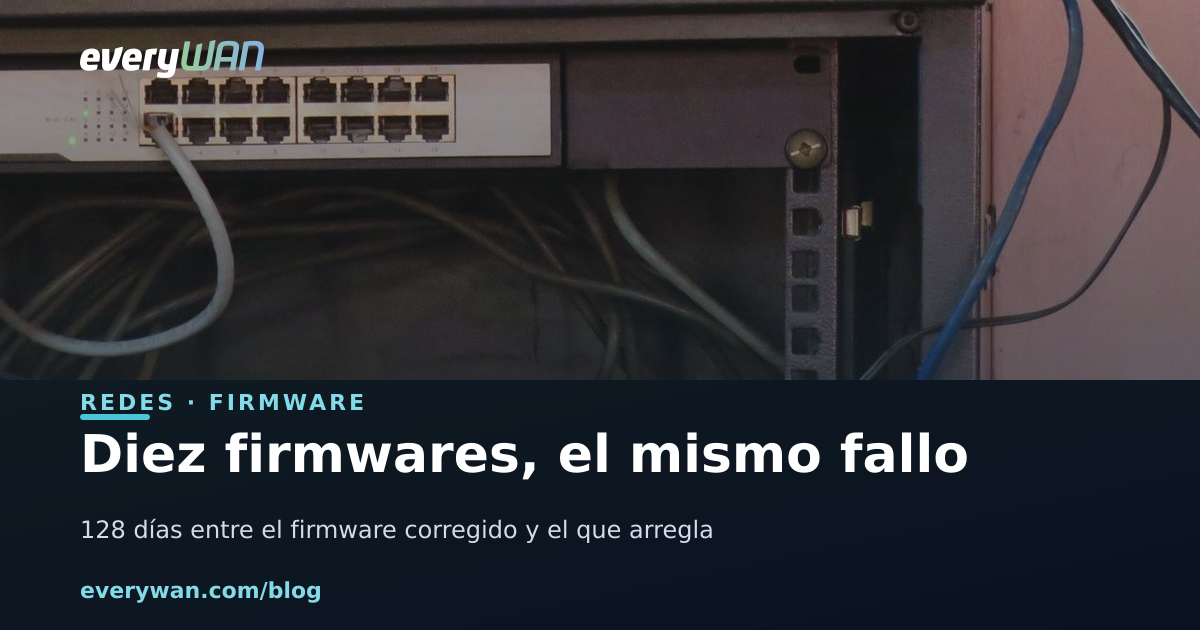
You applied the switch patch and stayed exposed for 128 days

On 16 June Zyxel published ten fixed firmware releases for its GS1900 switches. On 3 November it published another advisory: all ten carried the same flaw inside. Binarly's binary diff shows why the June patch left the flaw inside — it checked the parameter counter after copying the parameters — and leaves a question no firmware answers: what to do when what left 996 switches were the configurations and the root credentials. Includes a correction to something we wrote ourselves in September.

Regletas de conexión de un repartidor de cableado con puentes de hilo azul y etiquetas de identificación
9 min read

Four CVEs in AuthPoint, and none of them touch the second factor

On 4 November WatchGuard published four vulnerabilities in AuthPoint Authentication Gateway, scoring 8.9 to 9.2 on CVSS v4, all fixed in 7.6.0. Read one after another, not one of the four is about the second factor: three are about the network stretch between the gateway and your local authentication servers, and one is about the machine the gateway runs on. We go through the four records one by one, what the CVSS vector says that the headline does not, and why the middle component you installed once is not in your patching inventory.

Sala de servidores pequeña con racks abiertos, servidores en bandeja y cableado estructurado
9 min read

XSA-523 has no mitigation: it has a host reboot

The Xen advisory of 3 November says a malicious guest can read and write arbitrary memory belonging to other domains, including Dom0, and its mitigation section contains five words: "There is no known mitigation". The patch requires a host reboot. We counted Xen advisories year by year over the official JSON — 47 published in 2026 against 10 in all of 2025 — and go through why the grant tables are this year's hot spot, and what gets decided before the next advisory lands, which already has a date: 10 November, 18:00 UTC.

Armario de distribución de fibra óptica abierto con latiguillos naranjas y amarillos sobre los conectores
8 min read

Your SD-WAN rotates the key every 24 hours. So does the implant

On 28 October Cisco Talos published its analysis of KeyDrift, an implant that lives inside Catalyst SD-WAN controllers, hooks SSL_read and extracts key material from decrypted control traffic. It passes through there because Cisco's own manual says it does: the router generates the AES key and the controller distributes it to the peers, every 86,400 seconds by default. The uncomfortable part is the calendar: the countermeasure — pairwise keys — was already written into a CISA supplemental direction dated 25 February, eight months before anyone knew what it was for. The nine Cisco SD-WAN entries in the 2026 KEV, counted one by one, and the email we would send to whoever operates your controller.

Armario de comunicaciones con decenas de latiguillos de red azules y grises cruzados sobre los paneles de parcheo
8 min read

Seven fixed versions in the CVE and none of them boots your Proxmox

CVE-2026-98432 is a 9.8 in the Linux kernel: a use-after-free in the IPv4 TCP handshake, exploitable with no credentials and no interaction. The advisory lists seven fixed versions — 5.10.272, 5.15.223, 6.1.190, 6.6.159, 6.12.113, 6.18.56 and 7.2.10 — and not one matches the branch a Proxmox node boots. What actually triggers the bug according to the CVE's own field-by-field justification, the clocks of Debian, Ubuntu, Red Hat and Proxmox as of 31 October, what the published exploit proves and what it does not, and six checks with commands.

Pasillo entre racks de una sala de servidores a oscuras, iluminado solo por los pilotos verdes y azules de los equipos
9 min read

ESXi: the 2.7 we ranked fifth was a zero-day

On 30 July we put CVE-2026-41709 last on a list of five: 2.7 out of 10, "insufficient logging" in VMware ESX. Ninety days later CISA adds it to the Known Exploited Vulnerabilities catalog because an adversary had been using it as a zero-day. We go back over that post and correct two things: the doubtful window does not start on the advisory date, and shipping logs off the box does not fix a non-write.

Servidor de torre y documentación en el cuarto técnico de una pequeña oficina
9 min read

The software only your sector uses is the door nobody audits

In April 2026 a group got into US law firms through a signing key hard-coded into a time-and-billing application. CrowdStrike reports it in a 28 October publication, and it carries no CVE: we looked, and there is no public record. What an ASP.NET machine key is, the four times the same mistake has shown up in niche products since 2020, why your scanner cannot see it, and six questions to put to your vendor this week.

Subscribe to our newsletter

To receive IT stories, everyWAN news and exclusive subscriber offers, sign up to our mailing list

Minorisa de Sistemas Informaticos y Gestión S.L. © 2026
everyWAN
everyWAN