Tech Blog

everyWAN Blog

Technology, cybersecurity and IT trends that matter

Deep Analysis
Cybersecurity
IT Trends
Filter by:
Three milliseconds and 44 degrees: the cloud outage that had nothing to do with software
5 min read

Three milliseconds and 44 degrees: the cloud outage that had nothing to do with software

On 15 July 2026 a three-millisecond voltage dip on the utility feed took three services in a Google Cloud zone in the Netherlands out of service for almost fifteen hours. No CVE, no botched deployment, no BGP route: an electrical transient, a backup system that failed to pick up the load, a chiller controller that dropped offline, and a data hall at 44°C. What exactly failed according to the official incident report, why redundancy on paper is not always redundancy, what it means that a zone is not a building, and the seven questions worth asking any datacenter — including your own — before it happens.
VMSA-2026-0006: two 9.8s in vCenter, a VM escape and the flaw nobody will look at
5 min read

VMSA-2026-0006: two 9.8s in vCenter, a VM escape and the flaw nobody will look at

On 29 July 2026 Broadcom published VMSA-2026-0006: five flaws in VMware ESX, vCenter, Workstation and Fusion, two of them CVSS 9.8 in vCenter and one 9.3 that allows escaping from a virtual machine to the host. There are no workarounds. What to patch first according to the advisory itself (the order is no longer the one you knew), why updating vCenter does not stop your workloads, where the patches are if you hold a perpetual licence with no support, and why the lowest-scoring flaw — ESX may not record what an administrator does — is the one that hurts afterwards.

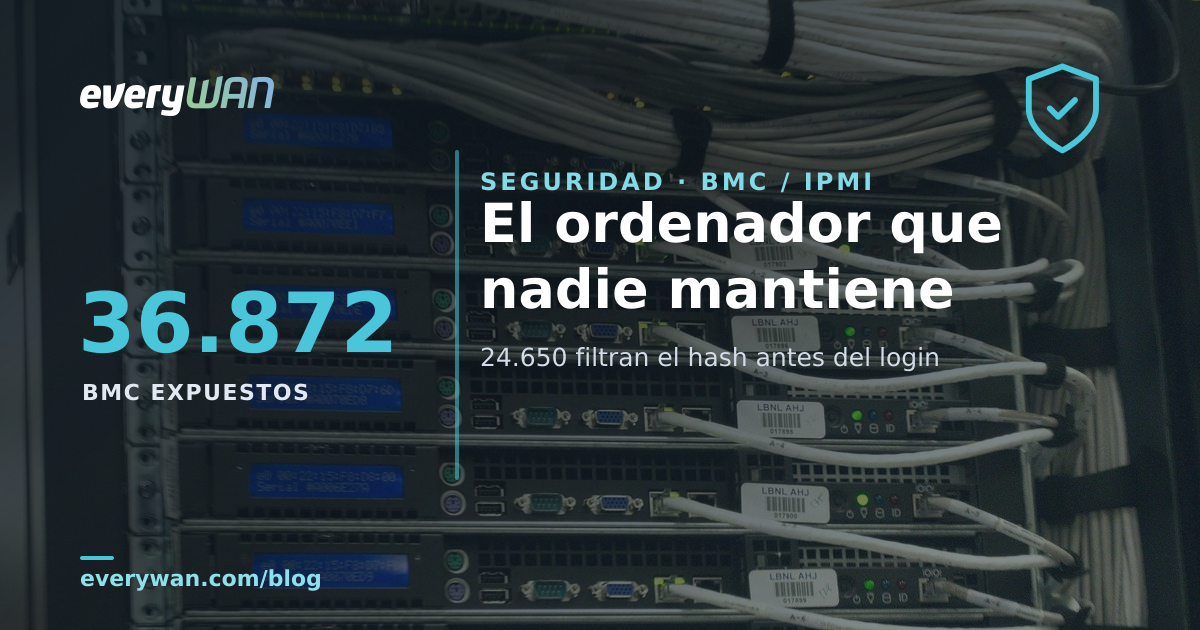
There is another computer inside your server, and 36,872 of them are on the internet
5 min read

There is another computer inside your server, and 36,872 of them are on the internet

A scan published on 29 July 2026 found 36,872 management controllers (BMCs) listening on the internet over UDP/623, and 24,650 of them hand out material derived from the account password before anyone logs in. This is not a new CVE: it is CVE-2013-4786, a flaw in the IPMI 2.0 specification itself, dating from 2004, which Dell acknowledges has no patch. The numbers, why a factory password falls in between 32 seconds and one hour, why your EDR will not see it and the six steps to close the management plane of your hardware.

Zabbix 8.0 release date, LTS and roadmap: what is real vs still a slide
5 min read

Zabbix 8.0 release date, LTS and roadmap: what is real vs still a slide

Zabbix 8.0 is the next LTS and half the industry already writes about it as if it were installed. As of 30 July 2026 the latest published artefact is beta 2, dated 9 July, and in the official container registry 8.0 is called trunk. Which features are really in the official release notes (native JSON up to 128 MiB, ClickHouse as a history backend, c-ares with DNS caching), what is still only roadmap (OpenTelemetry, complex event processing, mobile app, proxy permissions) and where the real bill for the upgrade sits: the database minimums and the removed macros living inside your alerts.

Proxmox VE 8 runs out of patches in August: why we won't upgrade on the 30th
5 min read

Proxmox VE 8 runs out of patches in August: why we won't upgrade on the 30th

The lifecycle table in Proxmox's official documentation puts the end of life of the 8 branch in August 2026. Just over thirty days are left, and the typical reaction is to block out a weekend and jump to 9. Our stance is the opposite: there are six situations where upgrading this August is a worse idea than being late. The live-migration asymmetry that turns your rollback into a restore, why Ceph means two windows and not one, the containers with old systemd that will not start, and a realistic split of the thirty days left.

Your monitoring is not broken: it is shouting
5 min read

Your monitoring is not broken: it is shouting

An organisation receives an average of 2,992 security alerts a day and 63% of them go unaddressed, according to Vectra AI's 2026 count. The interesting part is that the volume has been falling for three years and the unaddressed share has not moved. Filtering harder does not fix it, because the problem was never how many alerts arrive: it is how many arrived with an owner and an action written next to them. How we prune monitoring that shouts, what wakes us at three in the morning, and what waits for the morning report.

AI took the RAM: what to do with your 2026 hardware plan
5 min read

AI took the RAM: what to do with your 2026 hardware plan

TrendForce forecast second-quarter contract price rises of 58% to 63% for conventional DRAM and 70% to 75% for NAND. In one quarter, with nothing inside your company to explain it. Why the big cloud providers are hedged by multi-year contracts and you are not, how this lands in your refresh plan, what to check before signing a purchase order, and how long it lasts — with dates.

"latest" is not a version: three lessons from deploying our own website with Docker Swarm
8 min read

"latest" is not a version: three lessons from deploying our own website with Docker Swarm

The pipeline went green, the webhook returned 200, and the site kept serving the old content. Three real lessons from our GitOps CI/CD on Docker Swarm: why the orchestrator does not chase your tag and what it takes for a redeploy to actually redeploy, why a linter is not a test (and the smoke test that saved our blog index), and the "zero downtime" our own file claimed but never delivered with a single replica.

SD-WAN yes, but not everywhere: when it pays off and when it's overkill
5 min read

SD-WAN yes, but not everywhere: when it pays off and when it's overkill

Gartner predicted that by 2026, 70% of enterprises would have SD-WAN. We deploy it — and even so, more than once we have recommended against it. What problem it actually solves, when it pays off (changing sites, two transports, suffering applications), when two lines and WireGuard do the job, and the costs that never show up in the demo: the forever license, the orchestrator as a dependency and the complexity that doesn't disappear — it relocates.

The cloud isn't expensive: it's expensive for the wrong workload. Colocation vs public cloud, with the math done
5 min read

The cloud isn't expensive: it's expensive for the wrong workload. Colocation vs public cloud, with the math done

37signals was paying $3.2 million a year for cloud, bought $700,000 of servers and recouped them in the first year; in 2025 it announced moving its 18 PB out of S3. Meanwhile, worldwide cloud spending keeps growing at a 20% annual clip. Both things are true: the difference is who does the math. Which workloads overpay in the cloud, when the cloud still wins, and the five-year colocation math, line by line.

Subscribe to our newsletter

To receive IT stories, everyWAN news and exclusive subscriber offers, sign up to our mailing list

Minorisa de Sistemas Informaticos y Gestión S.L. © 2026
everyWAN
everyWAN