Tech Blog

everyWAN Blog

Technology, cybersecurity and IT trends that matter

Deep Analysis
Cybersecurity
IT Trends
Filter by:
Servidor de rack antiguo extraído sobre sus guías con la tapa quitada, dejando a la vista los ventiladores, los discos y la placa base
8 min read

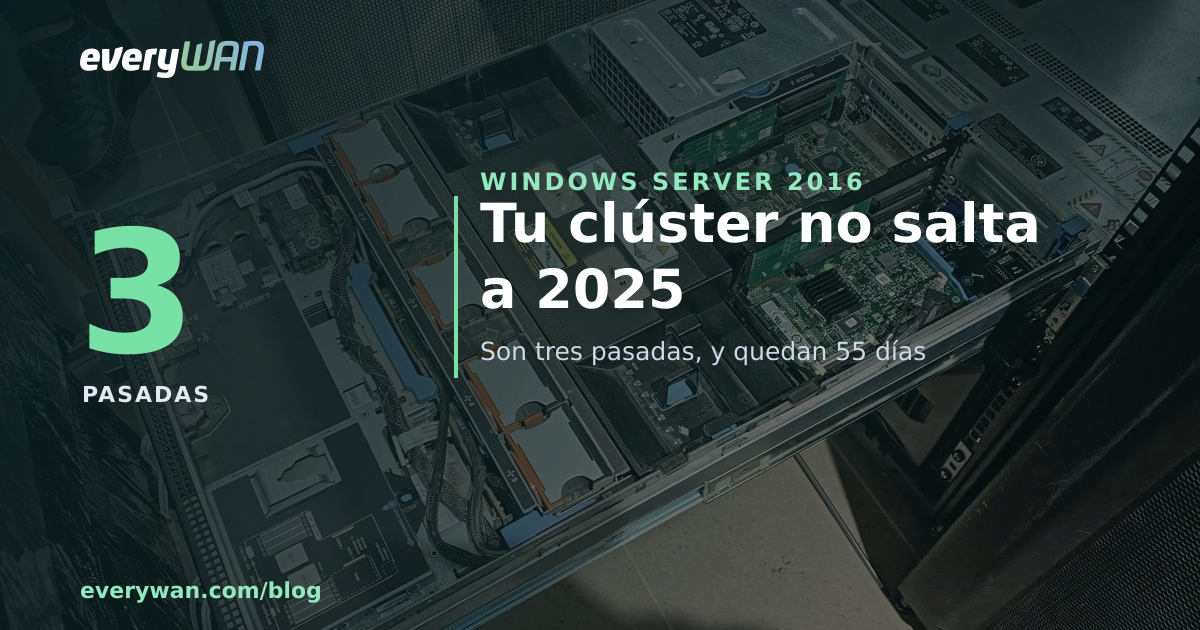
Your 2016 cluster does not jump to 2025: it takes three passes, and 55 days are left

Microsoft's documentation marks the Windows Server 2016 to 2025 jump as a supported route in a single pass. Three sentences further down, in the same paragraph, it takes that away from the machines you cannot stop: in a failover cluster you move one version at a time. That is 2016 → 2019 → 2022 → 2025, three passes with validation in between. The last cumulative update ships on 12 January 2027. Inside: why what does not fit is not the hours but the windows, the five things that break along the way and are written down, the four doors with their disqualifying requirement, and the five-column inventory that decides for you.

Primer plano de una tarjeta gráfica de doble ventilador apoyada sobre una mesa
8 min read

The patch for your AI server shipped in June; the advisory, in November

On 9 November CISA added a GPUStack 9.8 to its catalogue of exploited vulnerabilities: no credentials, full administrator. The fix had been published since 18 June, and that release's notes —thirty-six listed fixes— never once say "authentication", "security" or "localhost". Inside: why the standard nginx recipe is enough to exploit it, what upgrading does not fix, why EPSS puts it below the median on the very same day, and the question nobody asks about your company's AI box.

Estanterías de palets de un almacén logístico, el tipo de operación que se compra entera y se integra a medias
8 min read

You bought the company and inherited the system that is not in your inventory

On 11 November Maersk confirmed unauthorised access and data extraction from a legacy local system which the company says came "from a previous acquisition". Inside: what is confirmed and what only the extortionist claims, the three public dates and the one that never gets published, the four years and two months that what was bought in 2022 has stayed powered on, why the GDPR clock does not ask who owned the machine, the real state of NIS2 in Spain after the referral to the Court of Justice, and the six questions we ask when we take over an inherited infrastructure.

Armario de comunicaciones de pared abierto, con un conmutador de 16 puertos y una maraña de cables dentro
8 min read

257 bytes open the account you took the password away from

On 5 November 2026 OpenSSH shipped 10.6p2 to close a bug that, by its own developers' account, is not theirs. The musl maintainer says it is not musl's either. Both are right, and a root shell fits between those two sentences. Inside: how three defensible decisions taken in 2012 and 2016 end up comparing an asterisk against an asterisk; why the exploitable accounts are precisely the ones you left key-only; why OpenWrt shows up on every list and is almost never affected; and the four concrete checks for this week.

Dos teléfonos móviles con la pantalla apagada sobre una mesa de madera clara en una terraza
8 min read

A zero-day in December, off-the-shelf ammunition in August

For one week in August 2026, opening a Ukrainian gas producer's website on an iPhone was enough: the attacker had injected code into an analytics service loaded by thousands of pages. Sekoia published the analysis on 4 November and none of the three chains used a zero-day. One of them is DarkSword, a commercial surveillance kit whose code had been sitting on GitHub for five months. We reconstruct the campaign through the age of each piece's patch and end where it hurts: the iOS branch the oldest chain targeted was still receiving updates 108 days before the attack.

Armario mural de comunicaciones abierto con un switch de sobremesa y una maraña de cables de red sin ordenar
8 min read

You applied the switch patch and stayed exposed for 128 days

On 16 June Zyxel published ten fixed firmware releases for its GS1900 switches. On 3 November it published another advisory: all ten carried the same flaw inside. Binarly's binary diff shows why the June patch left the flaw inside — it checked the parameter counter after copying the parameters — and leaves a question no firmware answers: what to do when what left 996 switches were the configurations and the root credentials. Includes a correction to something we wrote ourselves in September.

Armario de comunicaciones con decenas de latiguillos de red azules y grises cruzados sobre los paneles de parcheo
8 min read

Seven fixed versions in the CVE and none of them boots your Proxmox

CVE-2026-98432 is a 9.8 in the Linux kernel: a use-after-free in the IPv4 TCP handshake, exploitable with no credentials and no interaction. The advisory lists seven fixed versions — 5.10.272, 5.15.223, 6.1.190, 6.6.159, 6.12.113, 6.18.56 and 7.2.10 — and not one matches the branch a Proxmox node boots. What actually triggers the bug according to the CVE's own field-by-field justification, the clocks of Debian, Ubuntu, Red Hat and Proxmox as of 31 October, what the published exploit proves and what it does not, and six checks with commands.

Mesa de oficina de madera al final del día, con un portátil abierto, un ratón y una silla vacía ligeramente girada
8 min read

Classic Outlook does not die in 2027: what dies is your COM add-in

The date exists and it is official: March 2027, the opt-out stage for Enterprise environments, announced in Message Center post MC949965 and postponed from April 2026. But opt-out does not mean it is taken away: it is on by default and you can still switch back, with classic Outlook supported "until at least 2029". The public page describing the stages was revised three days after that announcement and still does not carry it. What you do control: the list of what does not cross over — COM add-ins, VBA, custom forms, on-premises Exchange — and the registry key that decides the day.

Servidor de torre y documentación en el cuarto técnico de una pequeña oficina
8 min read

The software only your sector uses is the door nobody audits

In April 2026 a group got into US law firms through a signing key hard-coded into a time-and-billing application. CrowdStrike reports it in a 28 October publication, and it carries no CVE: we looked, and there is no public record. What an ASP.NET machine key is, the four times the same mistake has shown up in niche products since 2020, why your scanner cannot see it, and six questions to put to your vendor this week.

Pasillo de un archivo con estanterías llenas de cajas y archivadores etiquetados
8 min read

Your inventory has no line for Brotli

CVE-2026-111497 is an out-of-bounds write in Google's Brotli decoder: eight bytes of internal buffer from which Node.js, Bun, Python, Envoy, Istio, .NET, FFmpeg, ClickHouse and Apache Arrow all hang. In four days it had five names — Node2Shell, Python2Shell, HTTP2Shell, Brotli2Shell and Broccoli2Shell — and each one was somebody discovering the blast radius was wider than they thought. The fix had been public upstream since 27 February. The word that repeats across every advisory is "bundled": Arrow carries Brotli 1.0.9 inside it, .NET carries its own copy and ClickHouse maintains a fork. Why "is it patched?" has no single answer but eight separate clocks, why you are the one making the request rather than your perimeter, and the five-question census with the exact commands.

Pasillo de un centro de datos con filas de armarios de servidores y bandeja de cableado en el techo
10 min read

Your scanner says zero criticals and the exploit gets root

On 21 October 2026 the Zero Day Initiative sent five Linux kernel bug reports to the security team and, by mistake, to the public development lists. Three carried full proof-of-concept code. None has a CVE, because the kernel only assigns a number once the fix is already in a stable tree. And one of them has already produced root on AlmaLinux 8, 9 and 10, Debian 12 and 13 and Ubuntu 24.04 and 26.04, bypassing the Dirty Frag fix. We explain why the 9.0 probably does not affect you and the 7.8 does, what to check on each machine and the traps in checking it, and why the number that eventually shows up in your scanner is not a warning but a receipt.

Puesto de trabajo de oficina con un portátil, dos monitores, teclado y una libreta sobre una mesa de madera clara
8 min read

The signature was valid; the DLL next to it was not

On 19 October 2026 Siemens confirmed in-the-wild exploitation of CVE-2026-110936 in its Software Center. What ran on the victims' machines was a genuine, correctly signed copy of the program: the attacker only had to drop an archive.dll in the same folder. If your application control authorises "anything signed by a known publisher", this campaign passes the filter by design, not by failure. We explain what a digital signature answers and what it does not, why the CVSS vector says "local" while your patch queue reads that as "no rush", the three behavioural signals that do leave a trail, and the three questions you can answer this afternoon.

Armario de comunicaciones abierto con un panel de parcheo y decenas de latiguillos azules sin ordenar
8 min read

Redis: the patch had been out for 164 days

On 16 and 17 October 2026 a set of decoys recorded the first exploitation attempts against CVE-2026-25243, the flaw in Redis's RESTORE command. The patch was published on 5 May: 164 days earlier. Throughout those 164 days the flaw carried two scores — 7.7 from the party that published it and 8.8 from the NVD — that cannot be compared because they come from two different versions of CVSS; plus a CISA record dated 6 May that to this day still says "no known exploitation". We go through why those two scores cannot be subtracted from each other, why "requires authentication" does less work than you think, the six patched branches the CVE record itself never mentions, and the five checks that close the matter.

Armario de distribución de fibra abierto, con bandejas, latiguillos y módulos a la vista
8 min read

Two 10.0s in Arista EOS and no hotfix: your config decides, not your version

Two 10.0-out-of-10 flaws in data centre switches, both without a hotfix, published in September and with remarkably little noise around them. The reason for that silence is also the interesting part: nobody knows how many devices are affected, because exposure is not decided by the installed version but by two configuration lines almost nobody inventories. What the Arista advisories actually say, why they are 10.0 and not 9.8, the twenty-second check per device, and the three fields missing from any network inventory.

Interior de un armario de comunicaciones con regletas de conexión, latiguillos y un equipo montado en la pared
8 min read

The fix needs no window and no restart, which is why it may not be in place

On 14 October Cisco published a 9.8 flaw in its email gateway, exploited before the advisory went out. The striking part is not the score: it is that the fix ships as a scanning-engine package that "does not require a software upgrade or a product restart". That sounds like good news, and it is precisely what keeps it out of your patching process, which is built from tickets, windows and restarts. What to look at before that engine changes version, and why for an arbitrary file write "patched" does not mean "clean".

Filas de puestos de trabajo idénticos en una sala: mismos monitores, mismos teclados, misma imagen instalada
8 min read

Windows 11 24H2 stops getting updates today, and your fleet is on the latest build

Today, 13 October 2026, Windows 11 version 24H2 stops receiving updates on Home and Pro. Microsoft's own table lists the same cumulative update, KB5124010, in four rows with four different end dates, and two of those rows carry the identical build number: 26100.9550. One expires today; the other, the IoT Enterprise LTSC line, has extended support until 2034. The date is not in the code: it is in the edition and the channel.

Cuarto de cableado de un edificio con un conmutador sobre una balda, bloques de conexión antiguos y latiguillos sueltos
8 min read

Only one of the eight exploited flaws is in a network appliance

Joint advisory AA26-281A, signed in Spain by the CNI, lists eight CVEs successfully exploited by Flax Typhoon. One is in a network appliance, a Pulse Connect Secure; the other seven are software on servers: Bash and BIND ship with the OS, Struts travels inside a Java application, and ProFTPD, GitLab, ONLYOFFICE Docs and Strapi were stood up by someone on a specific day. Three were already in CISA's catalogue, two since November 2021 with the ransomware flag set. The counts done on the catalogue JSON, with the commands, and the three questions that actually build that inventory.

Armario de comunicaciones real con switch, regletas de conexión y latiguillos de fibra sobre pared de contrachapado
8 min read

Thirteen of ClearPass's twenty-eight flaws are in the agent, not the server

On 6 October 2026 HPE published advisory HPESBNW05158 with 28 ClearPass Policy Manager vulnerabilities: 10 critical, 11 high and 7 medium. The interim mitigation the advisory itself recommends names the CLI and the web-based management interface, both of them on the server. We classified all 28 by the component HPE names in each title: thirteen live in the OnGuard agent or the client software, which is to say on the laptops. Two of those thirteen are 9.8 criticals needing no prior authentication. Inside: the table of the thirteen, the end-of-maintenance note that decides whether yours is a patch or a branch jump, and the question worth answering before the change window.

Armario de red de oficina abierto, con un conmutador y una maraña de latiguillos acumulados dentro
8 min read

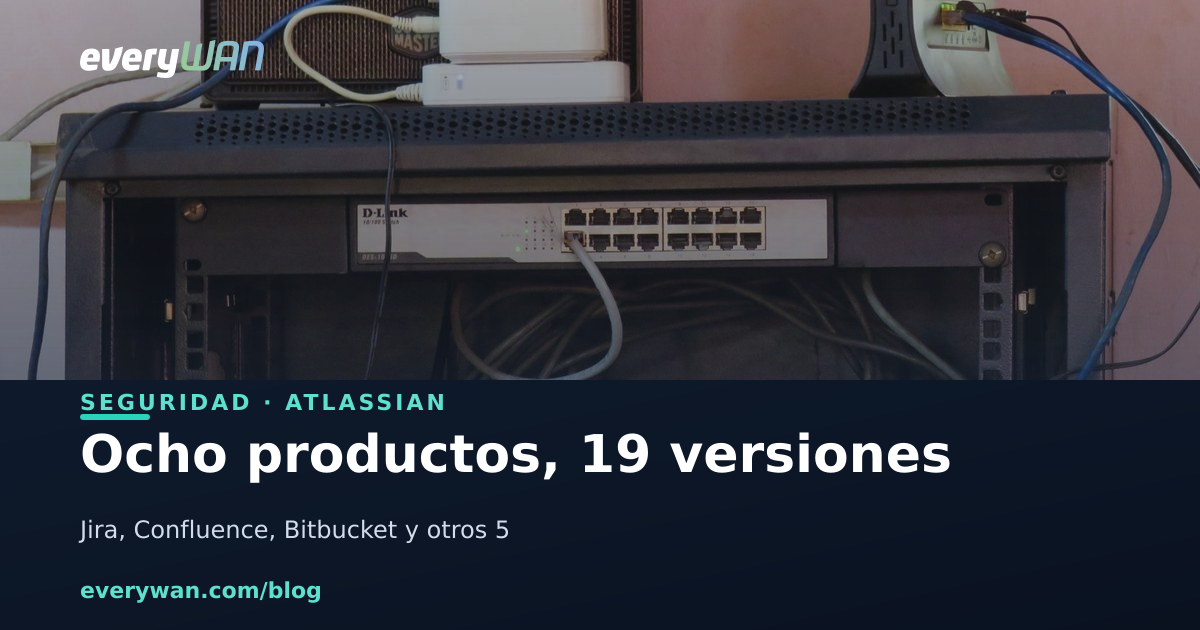
Eight products, nineteen versions: Atlassian's advisory tells you what to do, not what you have

The CVE-2026-21589 advisory, dated 5 October 2026, affects eight self-hosted Atlassian products: Bitbucket, Confluence, Jira Software, Jira Service Management, Bamboo, Crowd, Crucible and Fisheye. It is one of the thorough ones: nineteen fixed versions, temporary mitigations if you cannot patch —including taking the instance off the internet— and a method for hunting traces in your access logs. All three instructions start from a question the vendor cannot answer for you. Inside: the version table, why "we are on 10.2" points at three different products, and Atlassian's thirteen entries in CISA's KEV catalogue.

Subscribe to our newsletter

To receive IT stories, everyWAN news and exclusive subscriber offers, sign up to our mailing list

Minorisa de Sistemas Informaticos y Gestión S.L. © 2026
everyWAN
everyWAN