Tech Blog

everyWAN Blog

Technology, cybersecurity and IT trends that matter

Deep Analysis
Cybersecurity
IT Trends
Filter by:
Nave industrial vacía con el suelo de hormigón, un palé en primer plano y la puerta abierta al fondo
8 min read

Data Act: in January 2027 leaving the cloud becomes free; moving does not

On 12 January 2027 your cloud provider loses the right to charge you for leaving: Article 29(1) of the EU Data Act forbids it. But the big three already dropped that fee back in 2024, so what changes is not the amount — it is that this stops being a conditional credit programme and starts reaching the small providers too. The exit invoice disappears; the cost of leaving stays exactly where it was. The definition of "functional equivalence" speaks of "a minimum level of functionality", binds infrastructure services only, and covers only the features both source and destination offer alike. What you actually get back, what the trade-secret carve-out hides, why multicloud traffic still gets billed, the exact deadlines you can already enforce (two months, thirty days, seven months) and the exit drill that reveals the number no contract contains.

Reloj de pared de esfera oscura en una pared gris de oficina
8 min read

Cyber Resilience Act: 24 hours to report, and the clock does not start with the CVE

Article 14 of the Cyber Resilience Act starts to apply today: 24 hours for the first warning about an actively exploited vulnerability. Two details almost nobody is covering: it is the only article the regulation stretches backwards, reaching what you have already sold, and the deadline runs not from the CVE being published but from the moment you "become aware". That turns a legal obligation into an instrumentation problem: telemetry, a watched mailbox and who declares the time.

Sala de celdas de media tensión de una subestación eléctrica
12 min read

"Resilience" is in the title of Spain's data centre decree. It is not in the articles

The consultation window closed today at 17:00. The draft is called "energy and environmental sustainability, resilience and digital sovereignty requirements applicable to data centres", and its article 5 carries "resilience" in the heading. Read in full, it creates not a single resilience requirement: it defers them to whatever regulation already applies to you. We think that is sound legislative technique and bad news for anyone hoping somebody would hand them availability. It does not bind you — the threshold is 1 MW of grid access capacity — but it will reach you anyway, through the contract of whoever hosts you.

Enfriadoras de aire en la cubierta de un edificio industrial, con tubería aislada y grava, bajo cielo cubierto
8 min read

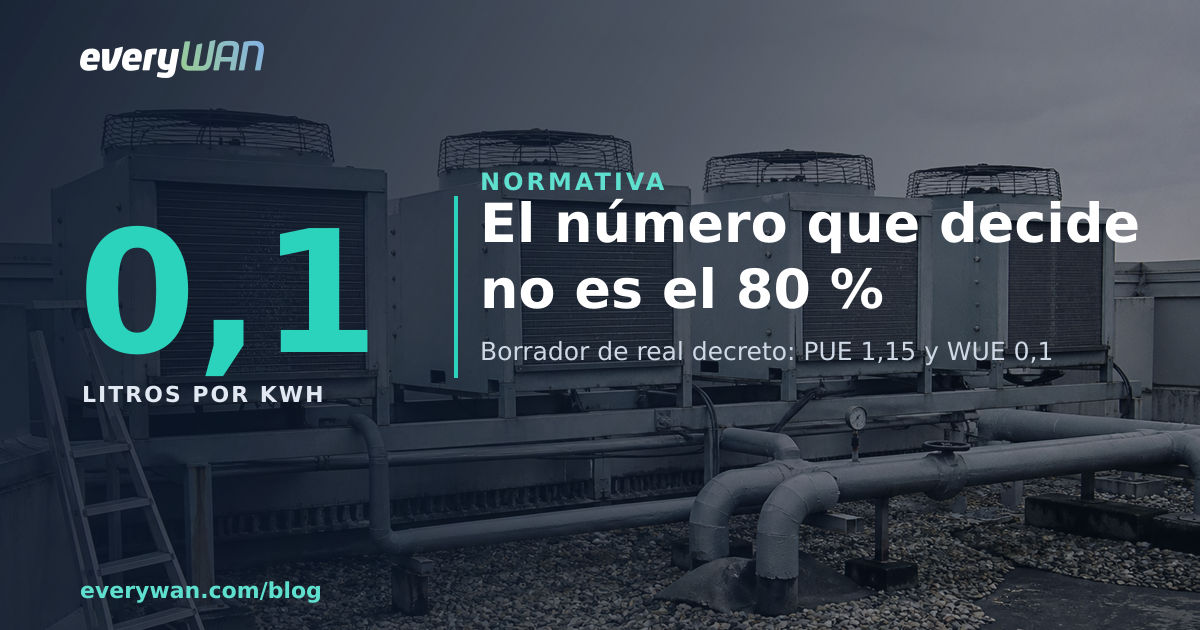
Spain's data centre decree is not decided by the 80% renewables rule: it is decided by a PUE of 1.15

On 27 August Spain opened public consultation on the draft royal decree regulating data centres. Coverage stopped at the 80% hourly renewables rule. We read all 32 pages and there are three things inside that almost nobody has reported: the surcharge scale in article 10, reaching 500% on network tolls and charges; a sentence in article 5.2(b) that leaves the customer's data outside the sovereignty the operator declares; and, in our judgement, the number that really filters projects, a PUE of 1.15 in the fourth transitional provision (with a WUE of 0.1 L/kWh), which the preamble itself acknowledges are the class "A" values proposed by the European Commission. Amazon reported a global PUE of 1.14 in 2025 and 1.15 in 2024.

Paso fronterizo vacío con la barrera levantada: la frontera de datos europea sigue dibujada y el tráfico pasa igual
5 min read

Three settings decide whether Claude processes your documents in Copilot, and one was decided by your tenant's creation date

Microsoft turned Anthropic models on by default in Microsoft 365 Copilot, but not in the EU. There are three separate settings with three different defaults, one of them depends on whether the tenant was created before or after 25 March 2026, and Microsoft's own documentation sends you to the Message Center to find out yours. What each source says, what cannot be inferred from them, and the twenty-minute review.

Fichero de archivo de madera con un cajón abierto lleno de tarjetas catalogadas: dónde vive de verdad cada documento y quién puede abrir el cajón

Warning: Undefined array key "read_time" in /var/www/html/public/blog.php on line 6086
min read

That recording lives in the OneDrive of someone who no longer works here

At the end of September, Microsoft moves whiteboards created in Teams channels out of the creator's OneDrive and into the channel's SharePoint site. It is a small change that concedes a large problem: much of a company's collective work lives inside one individual's personal account. Where each recording actually lands, why the deletion clock starts the day you delete the account rather than the day the person leaves, and why leaving the account blocked "just in case" is not the plan you think it is.

El AI Act ya aplica desde el 2 de agosto de 2026: qué obligaciones entraron de verdad, qué aplazó el Ómnibus digital sobre IA y el checklist de inventario de everyWAN
5 min read

The AI Act already applies to you — and not for the reason the headlines gave

On 2 August the bulk of the EU AI Act became applicable. Six days earlier, the Digital Omnibus on AI (Regulation EU 2026/1744, in force since 27 July) pushed high-risk obligations to December 2027 and August 2028. What does apply from 2 August is Article 50 — transparency — with fines of up to €15M or 3% (the lower amount for SMEs) and a date almost nobody wrote down: 2 December 2026. What actually changed, where Article 25 really bites, and the inventory checklist we run on a Microsoft 365 tenant.

Subscribe to our newsletter

To receive IT stories, everyWAN news and exclusive subscriber offers, sign up to our mailing list

Minorisa de Sistemas Informaticos y Gestión S.L. © 2026
everyWAN
everyWAN