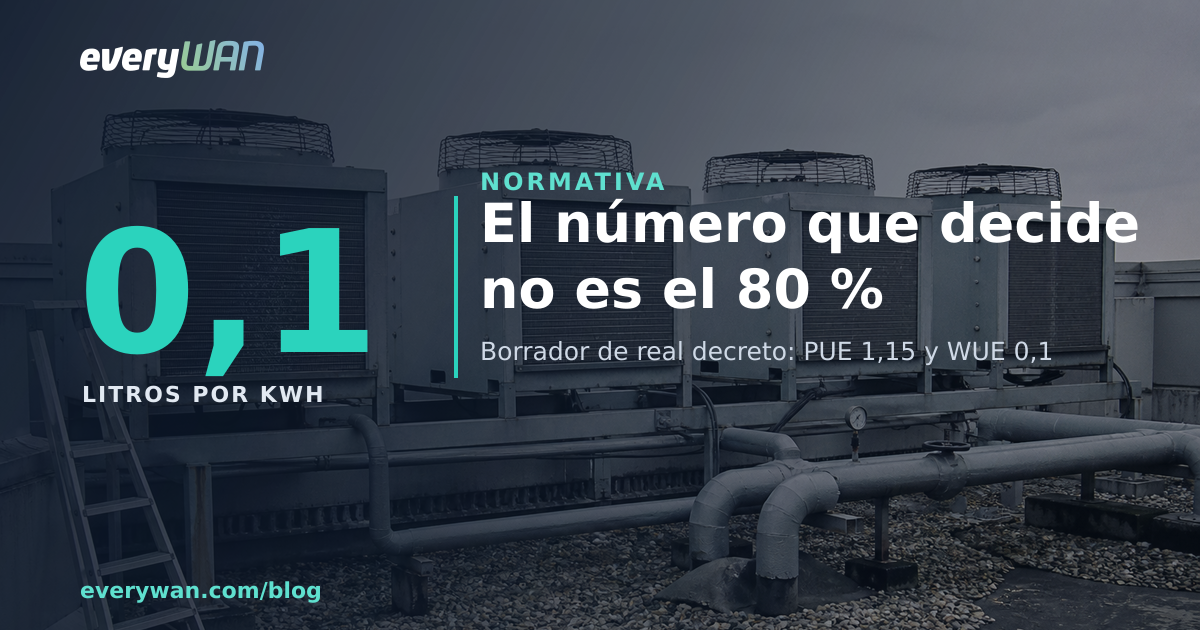
On 27 August the Spanish government opened an urgent public consultation on the draft royal decree that will regulate data centres in Spain. Coverage has stayed almost entirely on one phrase: 80% renewables, hour by hour. We downloaded all 32 pages and read them, and there are three things inside that almost nobody has reported: the surcharge scale in article 10, which reaches 500% on network tolls and charges; a sentence in article 5 that leaves your data outside the sovereignty your provider is about to declare; and, in our judgement, the number that really filters projects, which is not the 80% but a PUE of 1.15 buried in a transitional provision.
Conflict of interest up front: we sell colocation and we run our own hardware inside other people's data centres, so it makes us money if this worries you. Which is why everything below carries its article number, and the PDF is public and free. Go and check it.
Where it bites: at the socket
The text is titled Draft Royal Decree regulating the energy and environmental sustainability, resilience and digital sovereignty requirements applicable to data centres, and its mechanism sits in article 4: grid operators will only grant access and connection permits to the electricity network once three things are proven — digital sovereignty, energy and water efficiency, and renewables. There is no classic penalty regime. There is a key, and the key is the grid connection.
The general threshold is 1 MW of access capacity, and article 2.1 closes the most obvious back door: groups of data centres in the same location and under the same ownership that reach that megawatt in aggregate also count. You cannot slice it up. Article 2.4 leaves out centres dedicated exclusively to defence, civil protection and public security. And there is a second threshold, lower and barely mentioned anywhere: article 2.3 applies the publication duty of article 14 to centres with 500 kW or more of information technology power, regardless of their access capacity. The preamble supplies the context: since Royal Decree-Law 8/2023 the transmission grid operator has granted these facilities more than 6 GW of access capacity, with around another 6 GW granted on the distribution side since 2020.
A PUE of 1.15, in the fourth transitional provision
Article 6 requires class "A" of the European energy and water efficiency label. The problem is that the label does not exist yet, so the fourth transitional provision sets the numbers by hand in the meantime, calculated in line with annex III of Delegated Regulation (EU) 2024/1364:
- Power usage effectiveness (PUE) of 1.15 or lower.
- Water usage effectiveness (WUE) of 0.1 litres per kWh or lower.
Two clarifications from the preamble worth keeping, because they change who the bar should be attributed to. First: those two values are not a Spanish invention; the text says they are "the values corresponding to that class 'A' proposed by the European Commission" for the future labelling regulation. Second: the transitional regime lasts until that labelling scheme applies, expected in August 2027. So Spain did not invent the number: it decided to tie it to the grid access permit, which is a different thing and the one that matters.
| Metric | Draft requires | World average (Uptime 2025) | AWS, reported 2025 |
|---|---|---|---|
| PUE | ≤ 1,15 | 1,54 | 1,14 |
| WUE (L/kWh) | ≤ 0,1 | — | 0,12 |
Uptime Institute publishes a global average PUE of 1.54 in its 2025 annual survey, and it has barely moved for six years. That 1.54 is the average of the installed base, fifteen-year-old halls included, so a large new build starts from a considerably better place and the comparison needs that caveat. The relevant reference is the other column: Amazon reports a global PUE for AWS of 1.14 in 2025 and 1.15 in 2024, with a WUE of 0.12 litres per kWh, and cites an IDC estimate of 1.63 for enterprise on-premises data centres. The draft's energy bar is, in practice, the one Amazon was reporting in 2024; and the water bar sits slightly below what Amazon reports today.
Our reading, flagged as our own judgement rather than published fact: the 80% renewables rule is the noisy condition and the PUE is the expensive one. A power purchase agreement is signed with money and an afternoon in a law office. A PUE of 1.15 is decided in the building design, paid for in steel and square metres, and cannot be fixed afterwards. You can argue the opposite well — that the genuinely hard part is not meeting the PUE once but sustaining the hourly correlation of article 9 year after year, with article 10's bill on top — and that is a fair objection. We still think the PUE decides first, because it decides whether the building comes into existence at all.
The surcharge scale nobody has published
The press has written "escalating penalties". The numbers are in article 10 and apply to network access tolls and electricity system charges. The additionality scale — how much new renewable generation backs your annual consumption, article 8 — looks like this:
| Additional renewable generation vs annual consumption | Surcharge |
|---|---|
| Under 20% | 500 % |
| 20% to 40% | 400 % |
| 40% to 60% | 300 % |
| 60% to 80% | 100 % |
The hourly correlation in article 9 — that the energy of each hour is 80% backed by renewable generation from that same hour — has its own scale: a 10% surcharge if you miss under 5% of the month's hours, 30% between 5% and 20%, and 50% above 20%, rising ten percentage points for every consecutive month of non-compliance. And anybody taking the article 7 route — the exemption when the national renewable share in year n-2 passes 90%, in exchange for a maximum number of grid consumption hours — who exceeds that maximum gets a 65% surcharge applied to every invoice that year, plus ten points for each additional consecutive year.
Another reading of ours, flagged as such: that 500% is not designed to be collected. No data centre business model survives multiplying the regulated part of its electricity bill by six, so the scale works as a switch rather than a penalty; it exists so that nobody reaches the bottom row. Article 11 follows the same logic: it allows access and connection permits to be withdrawn if you stay below 60% additionality for five consecutive years, or miss 20% of the hours for five years. With five years of runway, nobody will be able to say they did not see it coming.
What counts as an energy contract and what does not
Article 12 defines which forward power purchase agreements can be used to prove all of the above, and explicitly excludes hedges based on forward products traded on organised markets whose renewable origin is evidenced solely through guarantees of origin. Financial contracts signed by the parent company or another group entity are also out when the relationship between the facility and the generation plants is not reflected. It further requires a minimum ten-year term and notarisation as a public deed. And article 8.1 adds that the renewable plants must be located in Spain, commissioned no more than eighteen months before the data centre starts operating.
In practice: the green certificate you buy on a market and display in a sustainability report proves nothing for the purposes of this decree. You have to point at a specific plant, on Spanish soil, and sign before a notary for a decade. This rule is written in concrete and solar panels.
Water and power pull in opposite directions
Back to the two numbers in the fourth transitional provision for a moment, because they carry an internal tension we also flag as our own reading. Lowering PUE is mostly about spending less on cooling, and the classic, cheap way to cool well is to evaporate water. A WUE of 0.1 litres per kWh does not ban evaporation — AWS reports 0.12 while using evaporative cooling — but it does rule out using it intensively all year, and pushes towards closed loops and air, which draw more electricity. There are designs that meet both at once: high-temperature water in a closed loop, direct liquid cooling to the chip. They exist, they work, and they are a different facility and a different budget, not the tuning of an ordinary hall. That both thresholds were calibrated by the Commission on data reported by operators suggests, precisely, that they are aimed at that class of design.
None of this is a brochure detail. Cooling is, along with power, one of the two things that take down a whole hall when they fail, and we wrote about it here over a Google Cloud outage. A decree squeezing energy and water at once is reaching into the thermal design of every data centre built in Spain from now on.
The sovereignty being declared is the building's
Article 5 requires the facility operator to file a responsible declaration on digital sovereignty: EU establishment, control of support access from third countries, identification and contractual oversight of direct subcontractors. Paragraph 2 opens by bounding the scope — the requirements "shall be limited to the elements under the direct or contractual control of the obliged party" — and its point (b) closes it like this, verbatim:
"EU residency for the data, metadata and records it processes as part of operating the facility and which are under its control, not extending to its clients' systems, data or services over which it has neither access nor control." (article 5.2(b), our translation from the Spanish)
From there comes the thesis we find most useful in the whole text, and it is ours: the sovereignty label is about the building, not about your workload. When you see "sovereign data centre compliant with the royal decree" on a provider's website it will be telling the truth, and it will be saying nothing about where your database lives, which cloud you replicate to overnight, or where your backup ends up. That remains your own data architecture decision, with the same questions it had before the decree and nobody new to hand the responsibility to.
What will end up in your contract
Paragraph 3 of that same article 5 is a different animal, and it does travel all the way down. It forbids hosting National Security Framework systems handling data under public sector control, or linked to national security or defence, unless that data and anything derived from using the service, including metadata, telemetry, logs, replicas and backups, is processed, stored and transferred exclusively within the European Union. And it adds the operational part: the operator must write into its contracts the duty to identify, before hosting them, the systems subject to this, and to pass the prohibition down to clients, suppliers and subcontractors.
There is a deadline here that needs careful reading, because it is not what it looks like. The fifth transitional provision defers the enforceability of the whole of article 5 until a ministerial order from the Ministry for Digital Transformation comes into force, and that order has no date yet; from then on it allows six months to file the responsible declaration, including for facilities already in effective operation. In other words: this part is not limited to new builds. When that order lands, if you touch the National Security Framework — even tangentially, even because a town council buys your product — an addendum will arrive from your provider asking where your backup lives, and "in the cloud" will not be an answer. It is the same mechanics we saw with the NIS2 supplier questionnaire: the rule talks to the big one, and the big one passes it down by contract.
Three questions for your next colo renewal
If what you have is four rack units, none of this makes you a regulated party and there is nothing to buy this week. But the price of the kilowatt you will pay in 2028 is being decided over these weeks, and we recently wrote that colocation stopped being negotiated in U and is now negotiated in kW. Three questions short enough for an email:
- What is your PUE and how do you measure it? An answer with a number and a reference to the method is worth having; an answer with an adjective also tells you something.
- How do you back your energy: self-consumption or a PPA? And if it is a PPA, is it tied to specific plants in Spain or does it live off guarantees of origin? Article 12 has just turned that distinction into the difference between compliant and not.
- If you ever pay an article 10 surcharge, who pays it? Article 10.5 says the grid operator passes it directly to the final consumer — the data centre — when the network access contract is signed with the distributor, and to the retailer when that contract sits inside the supply contract. Neither branch is you. What happens next depends on how the energy clause in your contract is written, and no royal decree regulates that.
There is also a date that will save you the first question before long. Article 14 requires that, before 15 May each year, centres with 500 kW or more of IT power send the ministry the information in annexes I and II of Delegated Regulation (EU) 2024/1364, and that information is published on the MITECO website. Within a couple of cycles, your provider's PUE will be public data.
A draft, not a law
It is worth ending on a lower note, because everything above is written about a text still in process. The public consultation closes on 4 September and the draft may come out different, or not come out at all. The third additional provision itself allows the 90% share, the PUE and WUE values, the 80% coverage percentage, the eighteen-month window and even the time resolution of the hourly correlation to be changed later by resolution. Today's 1.15 could be a different number tomorrow. For applications in process, the first transitional provision gives three months from entry into force to prove compliance or they are refused; for projects holding permits but not yet connected, the third gives six months before they lapse.
With that caveat up front: a decree that makes the socket conditional on a PUE of 1.15 is choosing how many data centres get built in Spain and how big whoever builds them has to be. You can be for it or against it, and we are in favour of arguing about it with the number in view rather than the headline. If you are thinking about moving hardware over the next two years, that transitional provision changes the five-year maths between colocation and public cloud more than any commercial offer you will get this autumn.
Sources (consulted on 30 August 2026): every article, threshold, percentage, deadline and surcharge scale quoted comes from the text of the draft royal decree under public consultation at MITECO (opened 27 August, submissions until 4 September 2026), specifically: scope, the 1 MW threshold and aggregation by location and ownership, article 2.1; the 500 kW of IT power regardless of access capacity, article 2.3; the defence, civil protection and public security exclusions, article 2.4; the three permit conditions, article 4; the scope limitation and the sentence quoted verbatim, articles 5.2 and 5.2(b); the National Security Framework block covering metadata, telemetry, logs, replicas and backups and its contractual pass-down, article 5.3; class "A", article 6.1; the 90% renewable share route and the maximum hours, article 7; additionality, the requirement that plants be located in Spain and the eighteen months, articles 8.1 and 8.2; hourly correlation, article 9; all the surcharges (500%, 400%, 300%, 100%, 10/30/50% with ten points per consecutive month and 65% with ten points per year) and the pass-through to the final consumer or the retailer, article 10; loss of permits after five years, article 11; the PPA conditions, the ten years, notarisation and the exclusion of guarantees of origin, article 12; the annual submission before 15 May and its publication on the MITECO website, article 14; the option to change thresholds by resolution, third additional provision; the three- and six-month deadlines, first and third transitional provisions; the 1.15 PUE and 0.1 WUE calculated per annex III of Delegated Regulation (EU) 2024/1364, fourth transitional provision; and the deferral of article 5 until the ministerial order with six months thereafter, including for facilities already in operation, fifth transitional provision. From the draft's own preamble come the 6 GW-plus granted on transmission and the roughly 6 GW on distribution since 2020, and also that 1.15 and 0.1 are the class "A" values proposed by the European Commission and that the European labelling scheme is expected in August 2027. The 1.54 world PUE average and its six-year plateau come from the Uptime Institute Global Data Center Survey 2025. AWS's global PUE of 1.14 in 2025 and 1.15 in 2024 and the 0.12 L/kWh WUE come from Amazon's AWS sustainability page; the 1.63 figure for enterprise on-premises data centres on that same page is an IDC estimate (doc. US51911924, January 2025) cited by Amazon, not a measurement of its own. Method warning: the decree requires PUE and WUE to be calculated per annex III of Delegated Regulation (EU) 2024/1364, and the Uptime and AWS figures are not calculated that way, so the table comparison is an order of magnitude and not an equivalence; the 1.54 is also an installed-base average rather than a new-build one. These are ours, and we flag them as judgement rather than published fact: that the number filtering projects is the PUE and not the 80%; that a WUE of 0.1 rules out intensive use of evaporative cooling and therefore puts the PUE itself under strain; that a 500% surcharge works as a switch rather than a penalty; and reading article 5.2(b) as a label on the building rather than on the customer's workload.
Do you know what your colocation contract says about energy?
We read the energy and data clauses in your current contract, tell you what does and does not get passed on to you, and if you touch the National Security Framework we prepare your answer before the addendum arrives. If it turns out you are covered, we will say so and sell you nothing.
Talk to everyWAN

 Microsoft 365
 ES
ES  CAT
CAT  EN
EN