On Monday 9 November, a remote management software vendor posted a recommendation on its status page that you almost never get to read. It was not asking anyone to apply a patch: it asked on-premise customers to "temporarily take their N-central servers offline and keep them offline until N-able provides further guidance confirming they can safely be brought back online". Switch off the console you administer every machine from, and leave it off.
It does not matter whether you use that product. The question it leaves on the table is not a product question: how many hours can your company run without the system that patches, inventories, monitors and logs into every one of your machines? And who on your payroll finds out, on a Sunday night, that it has to be switched off? We are a managed services provider, so this story includes us: it is about the piece everybody has and nobody puts in the contingency plan, because it is precisely the piece you use to run the contingency plan.
What the notice says, with the clock on it
The notice comes from N-able, the vendor of N-central, a remote monitoring and management platform used by IT providers and in-house teams to administer entire fleets. We read it straight from their public dashboard rather than from the press, and it is worth saying how, because that part became a story of its own. At 12:34 UTC today the incident was logged as opened on 9 November at 15:15 UTC, carried three updates, and spoke of a "public disclosure and non-responsible communication of critical vulnerabilities". At 13:10 UTC we looked again and the record was a different one: a different internal id, an opening time of 14:00 UTC, a single update, the word "non-responsible" gone, and a new paragraph. The dashboard keeps no history — the module that would keep it is switched off — so all that is left of the morning version is whatever you downloaded.
What has not changed between the two versions is the part that matters: a "Major Outage" severity and six services affected at once — hosted N-central in the Americas, APAC and Europe, and on-premise N-central in the same three regions — the precautionary shutdown of the vendor's own cloud ("as a precautionary measure, we have temporarily taken our Hosted N-central environments offline") and the advice to on-premise customers, which the text flags as "strongly advises". That is where two contracts people sign thinking they are the same thing come apart: hosted customers had it switched off for them; on-premise customers were advised to switch it off themselves. Mid-afternoon on a Monday, one group found out after the fact; the other had to find out, decide, and do it.
What has changed is the line that matters most operationally. This morning it read: "At this time, we have not seen any active exploitation of these vulnerabilities". The afternoon text reads: "As expected, we are observing scanning activity associated with the published proof-of-concept code. At this time, however, we have no evidence that any customer environment has been successfully exploited". There is still no confirmed breach, and that nuance matters when the headline landing in your Slack says otherwise; but somebody is already trying keys in the door, and that changes the arithmetic of how long you can wait.
What they have done well deserves saying, because it is uncommon. They acknowledge the damage without dressing it up: "We recognize the significant operational impact these actions may have. We do not take this step lightly". And in the 09:46 UTC update — the last one we saw before the rewrite — they said something a marketing department would have cut: that the estimated fix time is "a provisional time that may move", because they want the build to "pass our normal quality standards even in these challenging circumstances". The other half deserves saying too: the promise of updates "every four hours" appears inside the 05:00 UTC update, thirteen and three-quarter hours after the incident was opened, and the next one arrived forty-six minutes later than promised. Thirteen hours of silence is a lot of on-call nights.
Six days between "upgrade" and "switch it off"
An earlier notice, from 3 November at 15:00 UTC, is still open on the same dashboard. It reads: "On-premises customers should upgrade to N-central 2026.4 HF1 as soon as possible". The patch shipped on 2 November at 18:30 GMT, build 2026.4.0.32, and what it fixes is the operating system underneath: N-central runs on AlmaLinux 9, and the hotfix carries the distribution's security updates, among them CVE-2026-98432 — a use-after-free in the Linux kernel's IPv4 stack, 9.8 according to its NVD record and to the vendor's own notes — and CVE-2026-114406, which removes trust from a set of root certificates. About the third one, CVE-2026-111497, they write a sentence almost no vendor writes: that N-central does not use the affected Brotli decoder and is therefore not vulnerable, but that they are updating anyway as good practice.
Between that "upgrade as soon as possible" on the 3rd and the "keep them offline" on the 9th there are six days. Both instructions are correct, they do not contradict each other, and both demand exactly the same thing from your side: that somebody is reading. The difference lies elsewhere. What the hotfix fixed had a number: three CVEs, their scores, their NVD entries, their line in the scanner report. What forced the platform offline six days later lives in the application on top and, as we write this, has none: querying the NVD for "N-central" returns 28 records and the most recent was published on 6 September. Your vulnerability scanner can only show you the layer that already has a number, and the one that takes you down on a Monday tends to run ahead of the catalogue.
The material was published on Sunday the 8th under the name Able2Shell, and the figure going round the press is 33 zero-days with proof-of-concept exploits. That figure we cannot verify ourselves: the vendor has given no number in any of its communications, and GitHub's public repository search returns no result today for "Able2Shell". On authorship, the record is uneven: BleepingComputer identifies the researcher as Sean Bales and says it spoke to him; other outlets name nobody and cite only the GitHub account it was published from. So we leave the figure where it is, as what it is, and keep what the vendor has actually signed: they were enough to switch off three regions. If you want the procedure for when the patch does not exist yet, we wrote it out in full in your patching policy has no entry for "no patch".
The loop: the thing that patches is the thing to switch off
When you switch off a file server, you lose files. When you switch off the management plane, you lose the ability to fix everything else: it is the only piece in the estate whose shutdown leaves you without the tool you were going to respond to the shutdown with. And what goes down with it is not one function, it is six:
| What stops working | Realistic manual stand-in |
|---|---|
| Remote access to user desktops | VPN plus remote desktop with MFA — if it exists and has been tested |
| Network and machine inventory | The inventory that lives OUTSIDE the tool (we use NetBox) |
| Patch deployment | Native OS updates and hand-patching by priority |
| Monitoring and alerting | Monitoring independent of the RMM (ours is Zabbix and SmokePing) |
| Scheduled scripts and automations | A written list of what ran, when, and what breaks if it does not |
| Onboarding, offboarding and new machines | A documented manual procedure, however slow and ugly |
In this particular case there was a lifeboat: the vendor kept its newer, cloud-side plane standing and published what was still available from there — asset view, patching, vulnerability management, scripting, policies and tagging — while opening up a Windows patching engine in preview, on demand only and remote control from the asset view the same day. And this is where the wrong lesson gets drawn. The lifeboat existed because the vendor had two planes; most installations we see have one. A single console concentrating access, inventory, patching and automation is cheap to run and convenient right up until it is not: on the bad day it is a single switch. On who actually holds the authority to flip a switch like that, we wrote after a different outage: someone you have never signed anything with can switch off your servers.
This did not start on Sunday
CISA's catalogue of exploited vulnerabilities — the list of flaws with evidence of real-world use, not of flaws that could be used — already held five entries for this same product before Sunday. We pulled them today from the official file, version 2026.11.09 released yesterday at 19:54 UTC, with 1,773 records in total:
| CVE | Added to the catalogue | Federal deadline | What it is |
|---|---|---|---|
CVE-2025-8875 | 13-08-2025 | 20-08-2025 | Insecure deserialization |
CVE-2025-8876 | 13-08-2025 | 20-08-2025 | Command injection |
CVE-2026-18577 | 03-08-2026 | 06-08-2026 | Authentication bypass: the incomplete patch for the next one |
CVE-2026-18556 | 04-08-2026 | 07-08-2026 | Authentication bypass via an alternate path |
CVE-2026-86218 | 08-09-2026 | 11-09-2026 | Pre-auth remote code execution (9.8 in the NVD; 10.0 in the vendor's CVSS 4.0) |
Two things from that table. One, the ordering: CVE-2026-18577 entered the catalogue a day before CVE-2026-18556, and 18577 is, per its own record, "the result of an incomplete patch for CVE-2026-18556". The patch for the authentication bypass reached the exploited catalogue before the flaw it was meant to close. Two, the deadline: the three 2026 entries carry three days for US federal agencies. That is not an exceptional deadline reserved for the worst cases — since CISA changed directive, three days is the shortest of the bands it uses and the one it hands out most: 155 of the 289 records added in 2026 — so the thermometer is not the deadline. The thermometer is that this product has been added five times. On what it means to trust an agent running with full privileges on every machine, we wrote in your IT provider's agent is attack surface. This is the next chapter: the server that commands all those agents.
Which channel does the bad news reach you through?
We measured this part ourselves today and it is reproducible in two minutes. The vendor has two public sites. One is the release-notes blog, which is a WordPress and therefore has RSS: the channel people subscribe to. The other is the status dashboard, a web app whose data only comes out if you query its API, which publishes no RSS and which, as we saw above, does not keep what it deletes. We asked the first one for November posts about the incident of the 9th: zero. There are two November posts that touch on security — the Risk Intelligence notice of the 6th and the hotfix release notes of the 2nd, which we quote above — but neither mentions the shutdown. The last things published there on the 9th are two product posts, at 14:18 and 21:39 UTC. The recommendation to switch the servers off lives, in full, on the other site.
Let us be fair to them: the 21:39 post is the preview patching engine, and the incident notice itself links to it as an alternative for anyone left without a console, so it is part of the response. The status dashboard can also be subscribed to. But the practical consequence does not change, and it is an awkward one: if your supplier monitoring is an RSS reader, on 9 November you would have seen a product announcement and not the recommendation to switch off. This is not about corporate communications. It is about a column that ought to exist in your supplier inventory, next to the name: where each of them publishes bad news, who on your side is subscribed, and what happens when it lands on a Sunday.
Runbook: 48 hours with no management plane
This is what we would run, in this order, the day one of our own management tools draws the short straw. It is written so you can copy it and adapt it, not so you can admire it.
First hour. Confirm the recommendation in the vendor's own channel, not in the headline: exact time, affected versions, what it says about active exploitation. And save a copy of what it says today, because that page can change underneath you. Before switching off, take the logs somewhere else: once the box is off, anything volatile is gone if you later need to look back. If switching it off outright is not viable, the intermediate step is taking it off the internet and leaving it reachable only from the management network, which is where it should have been all along.
First four hours. Check — by doing it, not by remembering — that you can get into the machines without that tool: a local or domain account that works, the server's management card, the VPN with its second factor. If the only way back in went through the agent you have just switched off, that is your finding of the day. Pull the inventory from wherever it does not depend on the tool, and warn the people it will hurt: users who will have no remote support today, and management, who would rather hear it from you.
The 48 hours. Hand-patch by priority — whatever is in the exploited catalogue and whatever faces the internet, in that order — and keep a list of what you did by hand, because when the console comes back you will have to reconcile. Keep some monitoring alive that does not depend on the downed plane, however minimal. And set a review date: if you are still without a console after 48 hours, it is no longer the vendor's incident, it is your continuity plan.
Powering back up. You do not come back all at once. One server first, validated against what the vendor says the new build fixes; then the rest. And the last step of the runbook is the one almost nobody takes: write down what was missing. Nobody bills you for this outage as a drill, but that is what it is, and it is the only one you are getting this quarter.
If reading this you thought you have "nothing like that", look harder. It is called Intune, or the backup server, or the EDR console, or Ansible, or the hypervisor, or that deployment script that has been running as domain admin for six years. Any piece able to execute whatever you tell it on every machine at once is a management plane, whatever the invoice calls it. And it comes with the same three questions: who updates it, who finds out when its vendor publishes something ugly, and how you work on the day it has to be switched off.
What we do, and what we are not going to promise you
It would be easy to close this with "which is why you should trust us". That is not the point. We also run tools with reach over entire fleets, and the only honest difference we can claim is how we treat them: inventory and network documentation live in NetBox, which is a source of truth and not an annex of the RMM; monitoring is ours, built on Zabbix and SmokePing, so it does not go down with anybody's console; and internal automations — self-hosted n8n, for instance — are inventoried as production services, with an owner and an update window, not as "a thing somebody set up once".
What we are not going to promise is that it will not happen to us. Monday's vendor is a serious company with an incident page, four-hourly updates and the decency to switch off its own cloud before anyone asked them to. If someone swears their management plane is immune, they are selling you something. Failure is inevitable; what gets decided at the design table is whether that failure turns into an outage. The difference between the two, on the day of the shutdown, is a two-page document written beforehand and tested at least once.
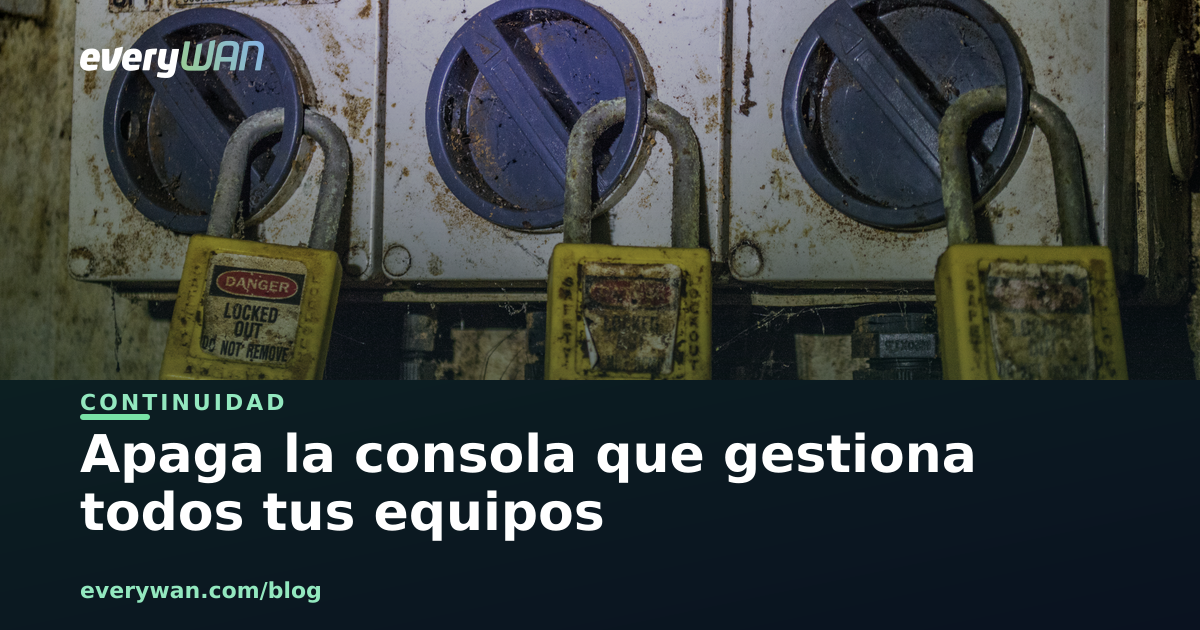
Sources (on 2026-11-10, from two captures of the same site: 12:34 UTC and 13:10 UTC): the whole incident comes from N-able's public status dashboard, whose data is served from its own API and whose history module is switched off. From the 12:34 capture, which we kept: opened on 2026-11-09 at 15:15 UTC, three updates, the phrase "public disclosure and non-responsible communication", the line "At this time, we have not seen any active exploitation of these vulnerabilities", and the updates at 05:00 UTC (where the promise of four-hourly updates appears) and 09:46 UTC (the source of "a provisional time that may move" and "pass our normal quality standards even in these challenging circumstances"). From the 13:10 capture, which is what anyone clicking the link will see: a different incident id, an opening time of 14:00 UTC, a single update, no "non-responsible", and the new paragraph about scanning activity. The "Major Outage" severity, the six services and "strongly advises" are in both. The earlier notice of 2026-11-03 at 15:00 UTC is still open on the same dashboard. The hotfix (build 2026.4.0.32, AlmaLinux 9, the three CVEs and the note that the Brotli decoder is not used) is in the release notes of 2026-11-02, 18:30 GMT. The 9.8 for CVE-2026-98432 and its nature (a use-after-free in the kernel's IPv4 stack) are from the NVD and match what the vendor publishes. For CVE-2026-86218 we give both scores because they are not the same thing: 9.8 is the NVD's primary CVSS 3.1 metric and 10.0 is the secondary CVSS 4.0 supplied by the vendor. The count of 28 records for "N-central" and the date of the most recent one (2026-09-06) come from the NVD API today. The five-entry table, its added dates and its deadlines are from CISA's Known Exploited Vulnerabilities catalogue, JSON file version 2026.11.09 released on 2026-11-09 at 19:54 UTC with 1,773 records; the 2026 deadline split (155 of 289 additions at three days) is our own count over that same file. The release-notes blog count is our own measurement against its public API and is reproducible. The figure of 33 flaws, the name Able2Shell, the Sunday 2026-11-08 date and the identification of the researcher by BleepingComputer come from the press, not from the vendor, and are flagged as such. Photograph: "Power Lockout", by darkday (Brisbane, Australia), CC BY 2.0 via Wikimedia Commons, original 6,016 × 4,000, cropped by us; the author's description notes that the padlocks have their keys in them, a detail we have not retouched.
How long can you run without your management plane?
We run the exercise against your estate: which pieces can execute something on every one of your machines, who updates them, how you get in if they are switched off, and how long coming back takes. It comes out as a document, not a slide deck. It is part of the RID Programme — security, workplace, infrastructure and data with a single team and monthly reporting — and of our compliance and continuity work. We are not resellers of N-able, nor of any of the management consoles mentioned.
Talk to everyWAN

 Microsoft 365
 ES
 CAT
 EN