Tech Blog

everyWAN Blog

Technology, cybersecurity and IT trends that matter

Deep Analysis
Cybersecurity
IT Trends
Filter by:
Migrating to Proxmox: the network is not held by the cluster, it is held by each node
8 min read

Migrating to Proxmox: the network is not held by the cluster, it is held by each node

In a VMware to Proxmox migration everybody watches the disks. Disks are the easy part: they either arrive or they do not, and you find out straight away. What gets left out of the luggage is the network configuration: in Proxmox VE it lives in a file on each node, outside the filesystem the cluster replicates. We go through the documentation sentence that says so, why the bridge is missing from the official list of live migration requirements, what the MAC change drags with it, the 10.0.2.x symptom that wastes hours, and how far SDN really takes you.


Spain's data centre decree is not decided by the 80% renewables rule: it is decided by a PUE of 1.15
8 min read

Spain's data centre decree is not decided by the 80% renewables rule: it is decided by a PUE of 1.15

On 27 August Spain opened public consultation on the draft royal decree regulating data centres. Coverage stopped at the 80% hourly renewables rule. We read all 32 pages and there are three things inside that almost nobody has reported: the surcharge scale in article 10, reaching 500% on network tolls and charges; a sentence in article 5.2(b) that leaves the customer's data outside the sovereignty the operator declares; and, in our judgement, the number that really filters projects, a PUE of 1.15 in the fourth transitional provision (with a WUE of 0.1 L/kWh), which the preamble itself acknowledges are the class "A" values proposed by the European Commission. Amazon reported a global PUE of 1.14 in 2025 and 1.15 in 2024.

Corosync adds 650 milliseconds per node: the clock your upgraded cluster is still carrying
5 min read

Corosync adds 650 milliseconds per node: the clock your upgraded cluster is still carrying

The time a Proxmox cluster takes to re-form membership after losing a node is not fixed: it grows by 650 ms for every node you add, and on factory values a 29-node cluster reaches 45.21 seconds — exactly where the documentation itself asks you to fix it, before the 60-second watchdog starts rebooting healthy nodes. Proxmox VE 9.2 lowered it to 125 ms, but only when the cluster is created: clusters upgraded from 8 to 9 keep the old value.

In Ceph, capacity is not set by the cluster: it is set by the fullest disk
8 min read

In Ceph, capacity is not set by the cluster: it is set by the fullest disk

A single OSD above 95% stops writes across the whole cluster even while "ceph df" still shows dozens of free terabytes. The three default thresholds (0.85 / 0.90 / 0.95), why the mechanism that repairs switches off five points before the one that serves, and the capacity calculation with one node missing that almost nobody runs: with four nodes the ceiling is 71 points, and 67 if you want the rebuild to actually finish.

Two ISPs are not redundancy if the ISP owns the IP
5 min read

Two ISPs are not redundancy if the ISP owns the IP

A second line saves what leaves the office, not what comes in: when the main one drops, the IP address changes, and with it DNS, open sessions, tunnels and third-party allow lists. The three real ways to have two paths, with 2026 figures: EUR 1,800 a year in RIPE fees, EUR 50 for the ASN, roughly 7,700 to 10,200 dollars for the /24 itself, and the ninety-second default of the BGP hold timer.

Gitea's flaw "requires write access". The signup form hands it to you
8 min read

Gitea's flaw "requires write access". The signup form hands it to you

The CVE-2026-60004 write-up says you need write access to a repository. The official vector in the same advisory says <code>PR:N</code>, privileges required: none. Both are true, because Gitea installs with <code>DISABLE_REGISTRATION=false</code>. What that means for how you prioritise patching everything you self-host, what happened in the eleven seconds of the only public case, and the list of what to check today.

When NOT to migrate from VMware to Proxmox
5 min read

When NOT to migrate from VMware to Proxmox

Migrating from VMware to Proxmox is part of what we do, and there are cases where our answer is: not now. Two classic objections no longer hold — the scheduler's dynamic mode arrived with Proxmox VE 9.2 on 21 May, and Veeam 13.1 has shipped replication since 29 July. The one still standing is different: Proxmox's HA documentation describes nothing equivalent to vSphere's <em>admission control</em>, which flatly refuses to power on the machine that would break your N-1. And the <code>crs</code> factory settings decide more than people think: <code>ha=basic</code> balances by counting machines. The five cases where we tell clients to stay.

Your identity provider is not an application: it is infrastructure
5 min read

Your identity provider is not an application: it is infrastructure

On Monday 24 August, at 03:38, a denial-of-service attack began against Norway's shared government digital platform. Ten public services went down and several had nothing wrong with them: the door everyone goes through had jammed. Digdir writes on its status page that <code>eSignering</code> was unavailable "because of the limitations in ID-porten", and also that the services were "stable with the limitations that have been put in place" — part of the outage was put there by the defenders. Why single sign-on is still the right call, what changes when the door becomes infrastructure, and the three questions that reclassify it.

Colocation is no longer negotiated in U: it is negotiated in kW
5 min read

Colocation is no longer negotiated in U: it is negotiated in kW

In the first half of 2026, AI cloud providers signed 420 MW of colocation capacity in Europe. In the same period a year earlier they signed 89. Powered land in the big markets costs 82% more than in 2021. None of that raises your invoice tomorrow, which is exactly why it is worth looking at today: what changes is not the price of a rack unit, it is what your contract actually measures.

Your servers can be switched off by someone you never signed anything with
5 min read

Your servers can be switched off by someone you never signed anything with

On 13 August more than 5,000 servers were powered off in a building in Phoenix, taking down the websites, email and DNS of thousands of companies. The decision to shut down was the right one; what is interesting is the chain the order came down, because the end customer sits at the bottom of it with no contract with whoever decides. What to ask about the building your hardware lives in, and why DNS took down people who were not even there.

Proxmox VE 8 goes end of life in August: Debian will keep patching you, the hypervisor will not
8 min read

Proxmox VE 8 goes end of life in August: Debian will keep patching you, the hypervisor will not

Proxmox's official table says 2026-08 and does not give a day. What tends to fall outside the headline is that Debian 12's extended support runs to June 2028 through the usual channel, so apt will keep installing real patches on an unsupported node. What exactly freezes, how to check it, the order of the upgrade to 9.2, and why forcing it in August can be worse than being late.

Ceph does not perform like the datasheet: it performs like the benchmark the OSD ran at boot
8 min read

Ceph does not perform like the datasheet: it performs like the benchmark the OSD ran at boot

Since Ceph Quincy the scheduler for BlueStore OSDs is mClock, and the work ceiling it shares out does not come from the vendor datasheet: it comes from a benchmark each OSD runs at boot. If that measurement is discarded, you are left with 315 IOPS for a spinning disk and 21,500 for a solid-state one, whatever you bought. How to check what your cluster believes, which parameters stopped having any effect, and when the drive really is the problem.

Proxmox HA does not prevent downtime: it shortens it (and sometimes causes it)
8 min read

Proxmox HA does not prevent downtime: it shortens it (and sometimes causes it)

Proxmox VE's own documentation sets the ceiling: about 2 minutes of error detection and failover, and no more than 99.999% availability. What really happens when a node dies (a cold start, not a live migration), why a healthy node reboots itself 60 seconds after losing quorum, the requirements everybody skips, and when we do not deploy HA at all.

RTO and RPO without the fluff: two numbers signed but never calculated

Warning: Undefined array key "read_time" in /var/www/html/public/blog.php on line 7258
min read

RTO and RPO without the fluff: two numbers signed but never calculated

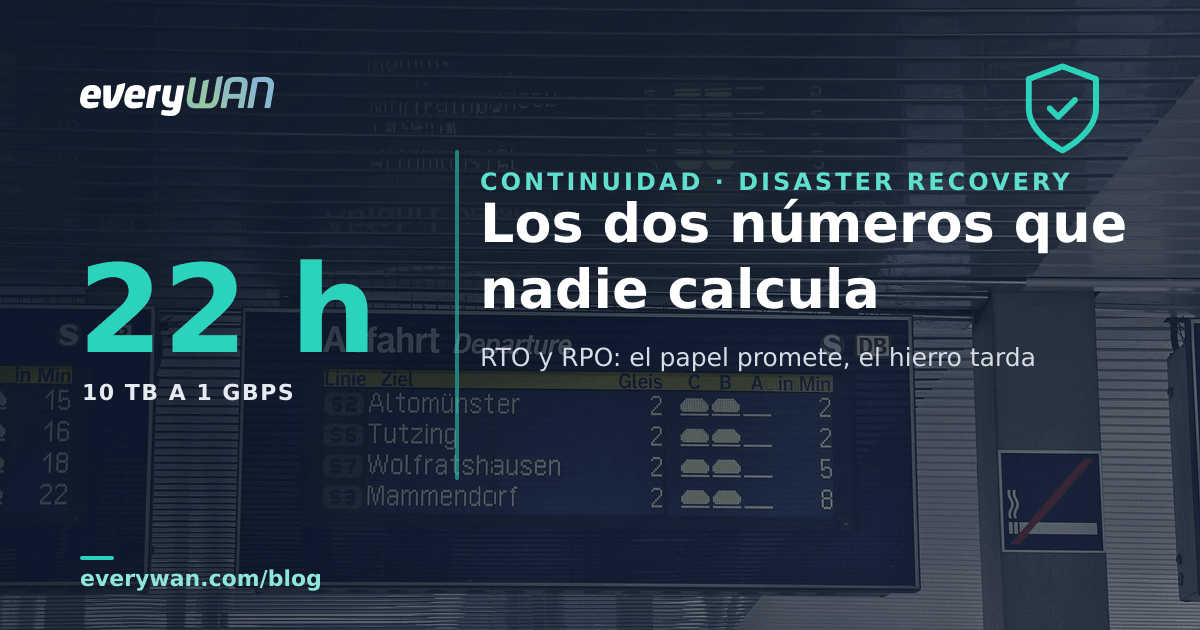
Almost every continuity plan carries an RPO and an RTO written with great confidence and calculated with none. What those two numbers actually promise, why your real RPO is the one of your last verified backup, the four clocks inside an RTO, and the arithmetic that dismantles a "four hours" sitting on a 1 Gbps link.

Zapscape and SCTPhantom: your Proxmox does not run Debian's kernel
5 min read

Zapscape and SCTPhantom: your Proxmox does not run Debian's kernel

Two Linux kernel flaws published this week break the two boundaries we take for granted: the virtual machine (Zapscape, CVE-2026-64561) and the container (SCTPhantom, CVE-2026-64564). Understanding them is the easy part. The hard part is answering whether the kernel your node actually boots already carries the fixes, because the versions in the advisory — 6.12.101, 7.1.6 — do not exist on your server: Proxmox does not use Debian's kernel. The exact proxmox-kernel versions that do close them (and why 7.0.14-9 is not enough), how to check in four commands, and who genuinely needs to hurry.

Fast EC ships switched off: the Ceph Tentacle flag that only turns once
8 min read

Fast EC ships switched off: the Ceph Tentacle flag that only turns once

Ceph Tentacle ships Fast EC, the erasure coding performance work people had been waiting years for. And it arrives switched off: you enable it pool by pool, with one command, and the monitor then refuses to clear it — rolling back means draining and recreating the pool. On top of that, the "at least double" in the headline was measured with a 16K stripe unit, which is precisely what an existing pool cannot have. The conditions the monitor enforces, the half of the improvement frozen on the day you created the pool, what happens to the cluster when you flip it, and why three-way replication is still faster.

Proxmox on Arm doesn't extend your cluster — it makes you run two
5 min read

Proxmox on Arm doesn't extend your cluster — it makes you run two

On 5 August Proxmox shipped the first officially supported edition of Proxmox VE 9.2 for arm64: same codebase, same repositories, same lifecycle and feature parity with x86-64. Buried in the announcement there is one sentence that decides how you design your infrastructure: guests only run on nodes matching their architecture, and live migration only works between nodes of the same architecture. What they actually shipped, what you give up crossing to Arm, why the Raspberry Pi is left out, and the five questions we ask before quoting an Arm node.

Half of corporate IT now lives off premises. That does not mean it went to the cloud
8 min read

Half of corporate IT now lives off premises. That does not mean it went to the cloud

On 28 July 2026 Uptime Institute published the figure that went around the industry: for the first time, third-party facilities (46%) overtake companies' own data centres (44%). The number is real. The "the cloud won" reading is not: that 46% puts colocation and SaaS in the same box, and they are opposite decisions. And the most interesting part of the report is not in the headline but in the remaining 10%, and in what is happening to kilowatts per rack.

Your Ceph has a date: Squid runs out of patches on 19 September
8 min read

Your Ceph has a date: Squid runs out of patches on 19 September

Ceph's lifecycle table puts the estimated end of life of Squid (19.2) on 19 September 2026: fifty days from today. Its replacement, Tentacle (20.2), has been stable since November and Proxmox has marked it stable since 9.2. The problem is not the jump, it is that it is not a jump: it is a sequence of three maintenance windows whose order you do not get to choose, with two details almost nobody has looked at — the mgr/zabbix module is gone, and erasure coding optimisations do not switch themselves on.

Subscribe to our newsletter

To receive IT stories, everyWAN news and exclusive subscriber offers, sign up to our mailing list

Minorisa de Sistemas Informaticos y Gestión S.L. © 2026
everyWAN
everyWAN