What you buy when you sign up for A+B power is not that the lights never go out. It is that they can take half the electrical installation out of service for maintenance on a Tuesday morning without you noticing. That promise is written on an assumption about your equipment that almost nobody checks: that every device has two cords and that each cord follows a different path. In the Uptime Institute's 2026 annual outage analysis power is still the leading cause of impactful outages, and within it the dominant items are UPS systems, transfer switches and generators: the moment of switching paths. Precisely the moment your rack has to ride through without blinking.
What you are actually buying with A+B
The property being sold is called concurrent maintainability, and it is both more modest and more useful than it sounds: any capacity component and any element of the distribution path can be taken out of service on a planned basis without the IT equipment noticing. It is not about catastrophes but about the maintenance calendar, which is what actually happens several times a year.
The small print is published and explicit. In the Uptime Institute's own journal, the 2014 reference article on dual-corded power puts it like this: Tier III and IV designs "continue to be based upon the use of dual-corded architecture and require an active-active, dual-path distribution". And the standard anticipated devices with an odd number of cords with a specific accommodation: a rack-mounted transfer switch, placed as close to the equipment as possible. The accommodation is there because the problem is an old one.
Electrical redundancy is a contract with two signatures. The provider brings two independent paths to the two strips in your rack. You put in the two cords, one per strip. If your signature is missing, the contract is not met and nobody tells you, because from the aisle your rack looks exactly like the one belonging to the neighbour who did it properly.
The fault does not show up until maintenance night
A server with both power supplies plugged into the same strip works perfectly 364 days a year. It boots, it survives one PSU dying, it raises no alarms and it passes any paper audit: it has two supplies, both lights are green, the record says "redundant". The mistake only shows up on the day somebody opens the breaker on feed A. And that day is not a day of bad luck: it is in the email they sent you a fortnight in advance.
How many people get it wrong? The only published figure we could find is old and its own author flags it as anecdotal, so we present it as exactly that. In the article cited above, from 2014, the Uptime Institute writes: "Anecdotal evidence has shown 1-10% of servers in a data center may be improperly corded, i.e., both cords are plugged into the A distribution". In the same piece, a colocation operator estimated that "greater than 50% of our clients continue to deploy at least one or more single-corded devices". Twelve years on we have no better number, and if anyone does we would like to see it. What we can say is that when we open a back door that order of magnitude does not strike us as exaggerated. That is an impression, not a measurement, and we offer it as such.
That same 2014 article reports that more than half of the 5,000-plus incidents in the Uptime Institute Network's abnormal incident reports (AIRs) database relate to the critical distribution system: the part from the UPS downwards, which is exactly where your two cords end up. Not the heroic generator; the power strip.
The list of things with only one cord
The servers are usually fine. What almost never appears on any list is the rest of the rack, which is where the single cord lives: the small branch firewall, the cheap access switch bought "for now", the serial console or the KVM, the box the voice provider left behind, the NAS used for quick copies, and the temporary 1U unit that has been there four years. None of them has two supplies. Several of them are, in practice, the point everything else passes through.
For each of those devices there are three honest ways out, and all three are defensible:
- A rack-mounted transfer switch. This is what the standard itself allows for. It has two drawbacks worth saying out loud: it costs money and it adds one more thing that can break between your equipment and the mains. Buy a good one or do not buy one.
- Duplicate the device instead of the cord. Two small firewalls in high availability, one per feed, sometimes cost less than a decent transfer switch, and they also cover the device dying on its own, which happens more often than a feed outage.
- Accept it in writing. "This device goes down when the provider services feed A; we are fine with that because it only affects X and we bring it back in Y minutes." That answer is as valid as the other two. What is not valid is never having chosen, which is what we have run into more than once.
Do it right and your rack has half the amps you think
If each feed has to carry all the load while the other is under maintenance, then neither of them can run full. The design also assumes the split is balanced in normal operation: the same article quantifies it like this, the normal load on each source is shared "within 10% of the average". At which point this stops being a cabling conversation and becomes a money one.
The arithmetic is ours and it is back-of-the-envelope, but it is what decides the bill. Two single-phase feeds of 16 A at 230 V give 16 × 230 = 3,680 VA each, about 3.6 kW real once you allow for the power factor of a PFC supply. That is not 7.36 kW of rack: it is 3.68 kVA usable, because on maintenance day a single feed has to carry everything. And check your contract before taking that at face value: in the ones we have read it is common for continuous load to be capped at a share of the rating, 80% being a frequent figure, which brings the real number down to around 2.9 kVA. A rack sold as "2 × 16 A" that somebody read as 32 A runs out of room halfway, and you find out with the server already bought.
We wrote about this when the market stopped selling space and started selling power: colocation is no longer negotiated in U, it is negotiated in kW. What this post adds is that the number that matters is the one left when one of the two feeds is gone.
The test is not the diagram: it is opening the breaker
There is a second figure that is relevant here. In Network World's coverage of the report, 92% of operators say human error was at least a minor contributor to their significant outages over the past three years, and within that category the leading cause is still the same one: failure to follow established procedures. People who have the procedure written down and did not follow it that day. Which is why the check we propose is not a paperwork exercise.
The only test that counts is: in an agreed window, open the breaker on feed A of your rack and watch what dies. Whatever stays up was fine. Whatever dies was wrong, and now you know it rather than finding out during the provider's maintenance in three months. Before you do it, one prior check that saves surprises: make sure that today both supplies on every server are alive. A PSU that died eight months ago lights no red lamp on any panel if nobody configured the alert, and on the day of the cut you discover you have spent almost a year without redundancy and did not know.
That alert is one line. The management controller on any branded server —IPMI, iDRAC, iLO— exposes the state of each power supply and whether it has mains input. We monitor with Zabbix and the rule is the same one we apply everywhere else: alerts that matter, not noise. "Power supply 2 has no input" is one that matters, because it is precisely the warning that your redundancy stopped existing while everything carried on working.
This is an argument for colocation, not against it
It would be easy to close this with "they sell you redundancy and you do not have it". That is not true and we are not going to write it. The difference between a data centre and the back room at the office is that in the data centre the second feed exists and all you have to do is use it. In the back room it does not exist, and no cable will invent it: there is a consumer unit, an RCD and a carpet. The failure this post is about is a failure to use what you bought, which is an infinitely better problem than not having the option.
And there is no point inflating the size of the problem, because the same report carries the figure that puts it in perspective: per-site outage rates are down for the fifth consecutive year. The industry is doing better, not worse, and nobody should buy anything out of fear. This does not call for an investment. It calls for one visit to the data centre, a while with a torch and, at most, two cords.
What we would do on your next visit
- Count cords, device by device, following each one by hand to its strip. Rack diagrams age worse than servers do.
- Read the draw on each strip and compare them. If one is well above the other, there is crossed cabling or a bad split, and during the cut you pay for it with a breaker tripping.
- Add up the total draw and compare it with what one feed can carry under your contract, not with the sum of both.
- List the single-corded devices and write next to each one which of the three ways out was chosen, with a date and a name.
- Leave the no-input PSU alert configured before you leave the data centre, not "when we get back to the office".
Three things we would not do. Call the rack fine because the provider is certified: their certificate describes what arrives at your strip, and from there to the server's power supply you are the designer. Run the cut test with no window and no warning, because the point is to find the fault, not to demonstrate it during office hours. And buy a cheap transfer switch for a critical device: if you are going to add a new point of failure in front of your firewall, make sure it is better built than the firewall.
The failure and the outage
We have been saying the same thing for years: the failure is inevitable, the outage is a design decision. What stands out here is that there is not even a failure. There is a Tuesday. Planned maintenance, announced, correctly executed and covered by the fee. The provider does exactly what it promised and your server goes down anyway, because both cords came out of the same place. A few weeks ago we wrote that redundancy does not buy immunity, it buys a window of time; this is the step before that: checking the window exists before working out how long it lasts.
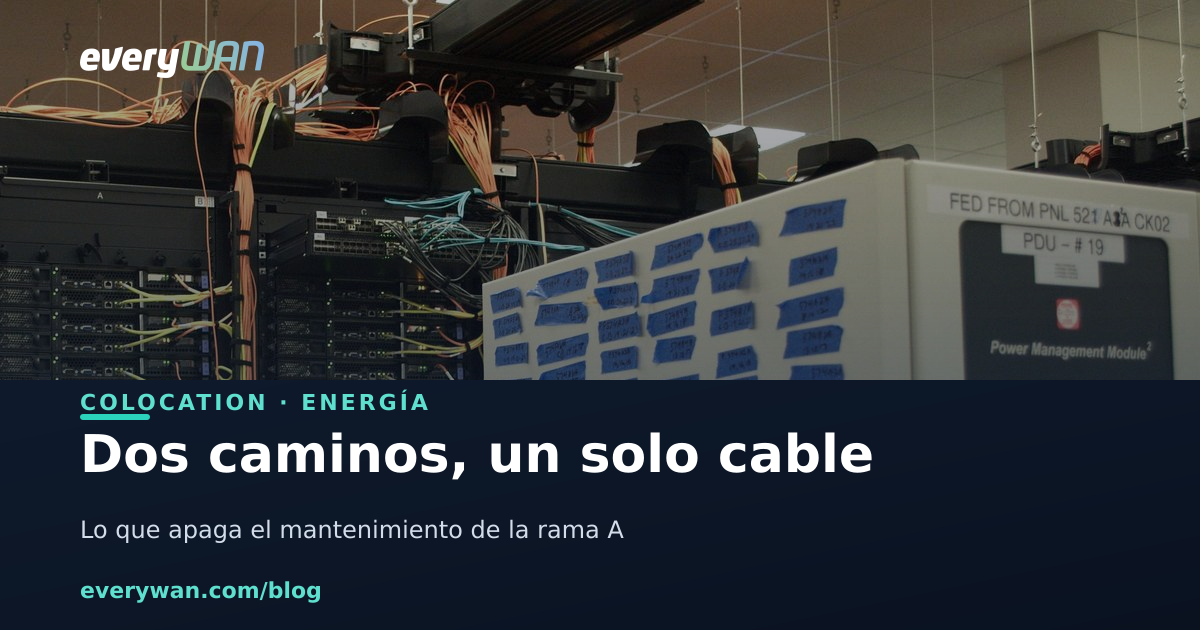
Sources and method (verified 9 October 2026): that power remains the leading cause of impactful outages and that UPS systems, transfer switches and generators dominate within it; that this is the fifth consecutive year of declining per-site outage rates; that around one in ten most recent outages had serious or severe impact; that 57% of respondents put their most recent major outage above $100,000 and one in five above $1 million for the second year running; and that "failure to follow established procedures" still leads the human-error causes, all come from the Uptime Institute's Annual Outage Analysis 2026 (eighth edition, published 13 May 2026) and its press release of the same day. The 92% of operators citing human error as at least a minor contributor comes from Network World's coverage of that report (14 May 2026). The verbatim quotes on dual-corded architecture in Tiers III and IV, the rack-mounted transfer switch accommodation for odd-corded equipment, the "1-10% of servers… may be improperly corded", the "greater than 50% of our clients continue to deploy at least one or more single-corded devices", the load shared "within 10% of the average", and that more than half of the 5,000-plus incidents in the AIRs database relate to the critical distribution system, come from "Dual-Corded Power and Fault Tolerance: Past, Present, and Future" by Kevin Heslin, Uptime Institute Journal, 18 August 2014. What we do not know, and what is ours: the miswiring figures are from 2014 and the text itself calls them anecdotal; we found no recent equivalent measurement, so we present them not as the current state of the industry but as the only published order of magnitude. The 3,680 VA per 16 A feed at 230 V, its approximate conversion to kW and the 80% continuous-load derating are our own arithmetic: the continuous load limit depends on your contract and your installation, and it must be read rather than assumed. The list of single-corded devices and the three ways out for each are our own judgement, not a recommendation from any body. Nor do we state what share of our clients' racks is miswired: we do not publish client data. Cover photograph: UPS Power Management Module, iDataPlex racks with network cabling in NERSC data center, by D. Coetzee, public domain (CC0 1.0) via Wikimedia Commons; cropped by us, otherwise unaltered.
Has anyone ever followed your cords by hand?
At everyWAN we run our own hardware in the data centre and we do IT maintenance with the boring part included: counting cords, reading per-feed draw and writing down which device goes down when the provider services feed A. We are not resellers for any platform and we take no commission on what we recommend, so sometimes the conclusion is "this is fine, do not touch anything". If you are moving racks, or nobody has opened the back door in years, get in touch and we will look at it with you.
Talk to everyWAN

 Microsoft 365
 ES
ES  CAT
CAT  EN
EN