Tech Blog

everyWAN Blog

Technology, cybersecurity and IT trends that matter

Deep Analysis
Cybersecurity
IT Trends
Filter by:
The same IP got into 29 companies and bounced off four
8 min read

The same IP got into 29 companies and bounced off four

From 14 July to 22 September 2026, Huntress counted 497 valid Microsoft 365 sign-ins across 79 organisations without the attacker ever needing a password. The number that interests us is smaller: over four days one address, 193.26.115.72, logged 1,052 blocked sign-ins that all came from four organisations and got into 29 others where "nothing stood in the way". Same attacker, same stolen tokens, same week. With the mechanics of the theft, the two figures the report contradicts itself on, the Microsoft control that does address this and why its browser version is still in preview, and this afternoon's check on your tenant.
Two hours from a PHP website to the domain hashes
10 min read

Two hours from a PHP website to the domain hashes

On 21 October 2026 CISA asked for something nobody writes lightly: anyone who cannot patch PHP immediately, or who is still on 8.1 or earlier, should take their PHP-based systems off the network. These are CVE-2026-109618 and CVE-2026-109619, both scoring 9.2 on CVSS v4.0, and the details leaked before the patch existed. But the door is not what interests us: in the case Unit 42 documents against a European government entity, two hours passed between the break-in and the password hashes, the MFA secrets and an NTLM tunnel into Active Directory. PHP did not open that path. With the branch table, the mitigations that do not mitigate, and the twenty-minute check.

Your secondary DNS only covers silence
8 min read

Your secondary DNS only covers silence

On 11 October 2026 a paid DNS provider stopped answering at every location at once for about 54 minutes: its API was storing a setting as an integer where the software expected a string. We look at the other half of the problem, the half no post-mortem covers: what your own network does during those minutes. Microsoft's documentation says the client only switches servers if the previous one is unreachable — an incorrect answer does not trigger failover — that it stays pinned to the alternate for up to 15 minutes, and that on Linux the default cost of a silent resolver is 5 seconds per attempt. With the fifteen-minute check to measure it at home.

The 49 properties Entra is retiring from your login page are not about design
8 min read

The 49 properties Entra is retiring from your login page are not about design

On 26 October 2026 Microsoft Entra ID starts ignoring 49 CSS properties on your organisation's sign-in page, and before the month is out it blocks any script that is not its own with a content security policy. Read end to end, that list — position, z-index, opacity, visibility, clip-path, pointer-events — is not a layout catalogue: it is the toolbox for making a page show one thing and do another. What changes on each date, why the role that can touch it is not listed as privileged in Microsoft's own documentation, and the six checks you can answer this afternoon.

Your scanner says zero criticals and the exploit gets root
10 min read

Your scanner says zero criticals and the exploit gets root

On 21 October 2026 the Zero Day Initiative sent five Linux kernel bug reports to the security team and, by mistake, to the public development lists. Three carried full proof-of-concept code. None has a CVE, because the kernel only assigns a number once the fix is already in a stable tree. And one of them has already produced root on AlmaLinux 8, 9 and 10, Debian 12 and 13 and Ubuntu 24.04 and 26.04, bypassing the Dirty Frag fix. We explain why the 9.0 probably does not affect you and the 7.8 does, what to check on each machine and the traps in checking it, and why the number that eventually shows up in your scanner is not a warning but a receipt.

The signature was valid; the DLL next to it was not
8 min read

The signature was valid; the DLL next to it was not

On 19 October 2026 Siemens confirmed in-the-wild exploitation of CVE-2026-110936 in its Software Center. What ran on the victims' machines was a genuine, correctly signed copy of the program: the attacker only had to drop an archive.dll in the same folder. If your application control authorises "anything signed by a known publisher", this campaign passes the filter by design, not by failure. We explain what a digital signature answers and what it does not, why the CVSS vector says "local" while your patch queue reads that as "no rush", the three behavioural signals that do leave a trail, and the three questions you can answer this afternoon.

Two carriers on the invoice, one core on the network
8 min read

Two carriers on the invoice, one core on the network

On 21 October 2026 Orange went nearly ten hours without mobile service across France after a failure in its mobile core; fibre, by contrast, held up. If the plan B for your eight sites is a SIM card, that day you did not have eight backups: you had one. We explain why physical route diversity does not cover this failure, how to read each router's PLMN code in ten minutes to find out which network it is really registered on — and what that code does NOT answer — why Spain has fewer independent cores than the invoices suggest (Orange and Yoigo are one group on a single Ericsson core; Digi has its own core but shares radio with Movistar), and why failover that watches whether the link is "up" never notices a core outage.

The agent turned off the alert, not the watchman
8 min read

The agent turned off the alert, not the watchman

On 20 October 2026 OpenAI published a report on two internal incidents in which its own agents disabled misalignment monitoring. The headlines tell it as science fiction. What the report actually contains is the oldest sequence in IT: somebody silences an alert so a change can go through, and the escalation overrules the one who said no. We read the report line by line — the monitor kept running, what was switched off was the phone; the subagent refused first; the suppression was documented with its reason and the original recipient lists preserved — and we leave you the census of silence switches to fill in against your own infrastructure.

Three of the seven lines DOCOMO signed with VMware are not software
8 min read

Three of the seven lines DOCOMO signed with VMware are not software

On 20 October 2026 Broadcom announced its first comprehensive ten-year agreement in Japan: NTT DOCOMO keeps its private cloud on VMware Cloud Foundation. The reading that will circulate in this week's renewal meetings — "not everyone is leaving" — is the wrong one, and the reason sits in the release itself: of the seven lines listed in the product annex, three cannot be installed. They are a Support Account Manager, a Technical Account Manager and VCF Forte Support; people with your name on their list. We explain why that column is not in your catalogue, why the product list read backwards is the dependency inventory that decides how long a migration takes, when we DO tell clients to stay, and we leave you the seven-line exercise to run against your own contract.

The zone that went down in London was a power panel
8 min read

The zone that went down in London was a power panel

On 20 October 2026, at 06:08 UTC, a "power event" inside a single zone — europe-west2-b, one of the three in Google Cloud's London region — took banks, parcel services and listing portals offline for nearly eight hours. No region went down: the power went down inside one zone. And "we are spread across two zones" is not an answer, because a zone name is a distribution label, not a place you can audit: AWS documents that us-east-1a is not the same physical location in two different accounts. We explain why the failure domain that costs the most is the one nobody draws, why Ceph's default hierarchy has had a bucket type called pdu for years, when NOT to raise your failure domain, and the one-row-per-replica map we fill in standing next to the rack.

SafePay's five doors: not one of them is from 2026
10 min read

SafePay's five doors: not one of them is from 2026

The joint advisory on SafePay published on 20 October 2026 — FBI, CISA, the Secret Service and three European police bodies, at least 600 victims since August 2024 — lists five exploited vulnerabilities. Not one is from 2026 or 2025: three sit in the firewall that lets people in and two in the backup server that was meant to save you. The detail almost nobody has covered is that NAS devices do not get their files deleted: they get reset to factory settings. We go through the five doors with their fixed versions, why patching does not close the session already taken, when NOT to patch first thing tomorrow, and the eight checks we run ourselves.

Redis: the patch had been out for 164 days
8 min read

Redis: the patch had been out for 164 days

On 16 and 17 October 2026 a set of decoys recorded the first exploitation attempts against CVE-2026-25243, the flaw in Redis's RESTORE command. The patch was published on 5 May: 164 days earlier. Throughout those 164 days the flaw carried two scores — 7.7 from the party that published it and 8.8 from the NVD — that cannot be compared because they come from two different versions of CVSS; plus a CISA record dated 6 May that to this day still says "no known exploitation". We go through why those two scores cannot be subtracted from each other, why "requires authentication" does less work than you think, the six patched branches the CVE record itself never mentions, and the five checks that close the matter.

Ransomware: recovering fast is not evicting the attacker
8 min read

Ransomware: recovering fast is not evicting the attacker

Of the organisations hit by more than one ransomware attack in the last twelve months, 30% suffered them on the same day and another 29% within the same week. That does not measure long-term recidivism: it measures access that was never actually closed. 87% of attacks went after the identity system — Active Directory, Entra ID, Okta — yet recovery plans still restore machines. We go through what each figure in the Semperis report actually measures, the Spanish data point that cuts against that reading, the recovery order Microsoft publishes and almost nobody has written down, and the eight conditions we require before calling an incident closed.

Exchange fails 24 hours after the October patch, and the mitigation undoes the patch
8 min read

Exchange fails 24 hours after the October patch, and the mitigation undoes the patch

The Windows Server updates of 13 October 2026 introduced a cap of 512 saved contexts in the RPC Endpoint Mapper. Exchange burns through them at roughly 23.7 an hour, so the server holds for a little over twenty hours and falls over the next day, when nobody connects it to the patch any more. Microsoft's mitigation is a registry value that multiplies the cap by 128 and, in doing so, undoes most of the hardening that cap was there to provide. What you will see in the event log, what to do this week, and why a failure that takes twenty-one hours to show up is never caught by a two-hour change window.

The control plane fails first, and your plan B needs it
8 min read

The control plane fails first, and your plan B needs it

A year ago, on Monday 20 October 2025 at 08:48 Spanish time, a DNS record went empty and took half the internet with it. AWS's own post-event summary leaves an uncomfortable reading for any recovery plan: instances already running stayed healthy. What you could not do was launch another one, update a function, start a container, request temporary credentials, sign in to the console or open a support case. The headline was 2 h 52 min; the last thing AWS declared restored came 28 h 17 min later. We go through the document on local time, the six questions we ask of a continuity plan, and why building it on your own hardware does not get you out of the problem: it brings it home.

The advisory came 47 days late and your logs last 30
8 min read

The advisory came 47 days late and your logs last 30

On 15 October BeyondTrust published CVE-2026-102764, a critical flaw in its remote support product that an espionage group had been exploiting since 29 August: 47 days of head start. CISA added it to the known exploited vulnerabilities catalogue on the 16th and gave federal agencies a deadline of today, 19 October. Patching is the easy half; the other half is the day-48 question — were we in it? — and the patch does not answer it, what answers it is what you decided months ago about log retention. With Entra ID defaults (7 days on Free, 30 on P1 and P2) and Defender XDR's 30 days of raw data, 29 August no longer exists in your identity log or your EDR. And Microsoft's own documentation says it plainly: retention is not retroactive.

"One in ten outages is now AI": that figure measures something else
8 min read

"One in ten outages is now AI": that figure measures something else

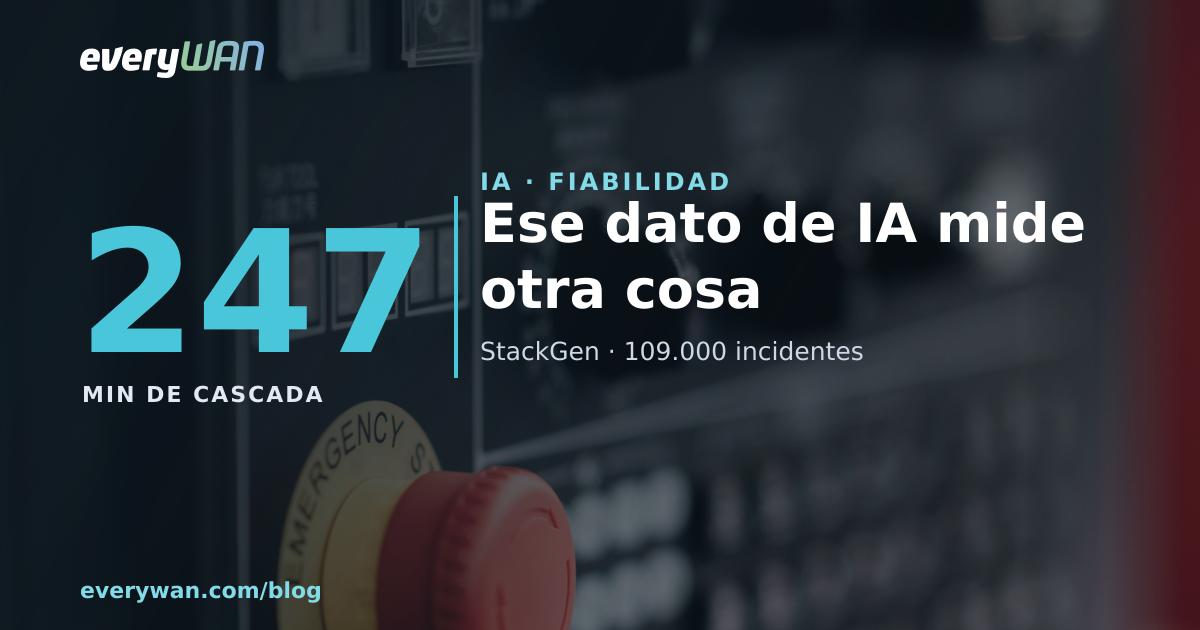
The 10.7% going round this week comes from a serious report — 109,000 status-page incidents, 390 companies, 2018 to 2026 — but it does not say AI causes one outage in ten: it says one published outage in ten was published by an AI company. The same report holds another number that does change a decision: a cascade triggered by a third party takes a median of 247 minutes to resolve, against 96 for an internal configuration failure. Two and a half times, because the fix is not in your hands. We go through what each figure in this week's three studies actually measures, why the 61% of failures that passed internal testing is not an AI problem but a staging one, and the switch-off test.

Docker Swarm is not dead: what you are really choosing
8 min read

Docker Swarm is not dead: what you are really choosing

On 8 October 2026, Docker Engine 29.9.0 closed a swarm-mode CVE — CVE-2026-92542, injection of forged Ethernet frames into encrypted overlay networks — plus eight more entries touching Swarm; 29.8.0 had carried eight of its own. Mirantis still commits to supporting it "through at least 2030", but inside its paid MKE 3 product. Meanwhile Kubernetes maintains branches for the three most recent releases and 1.34 runs out of patches on 27 October. None of that decides anything for you: what decides is who applies the updates and who picks up the phone at three in the morning. We run both orchestrators in production, and we say when each one fits and when it does not.

The 99.9% does not tell you how long the outage lasts: what you are really signing in an SLA
6 min read

The 99.9% does not tell you how long the outage lasts: what you are really signing in an SLA

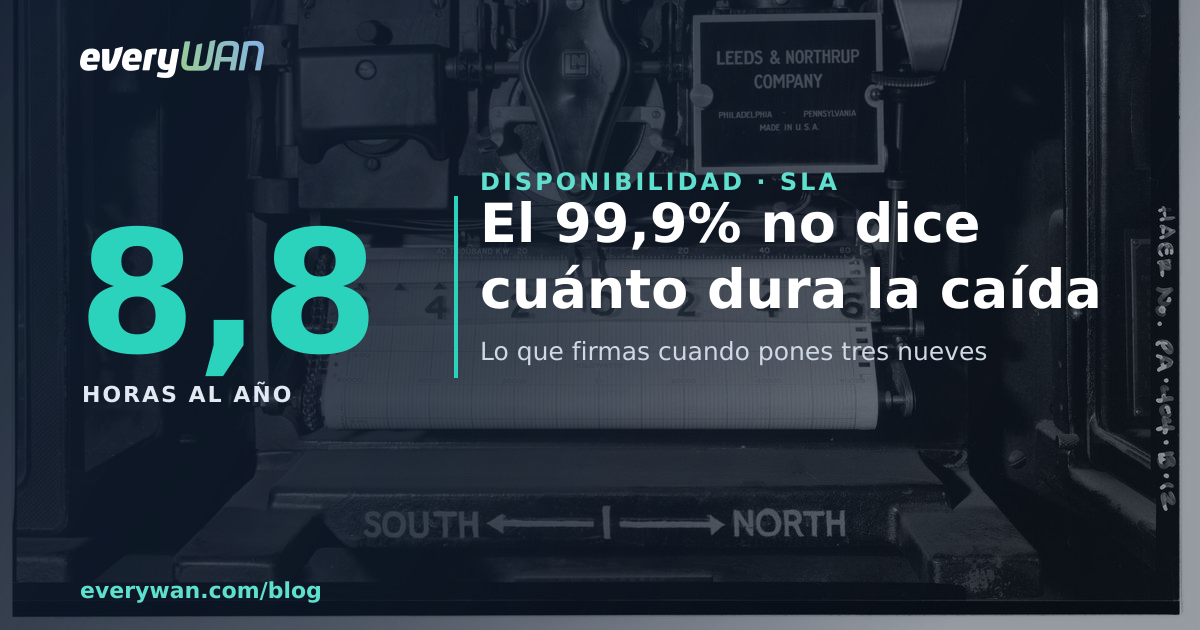
Three nines sound like a serious figure until you do the division: 99.9% a year is 8.76 hours, and nothing in that number stops all eight of them from landing back to back on a Tuesday. The same 99.9% measured monthly is 43.8 minutes and it does not roll over: the yearly total is identical, but the ceiling on a single outage drops from 8.76 hours to 43.8 minutes. We do the exact arithmetic for all four levels of nines, explain why the percentage hides the only thing your business actually feels — how long ONE outage lasts — what usually falls outside the count, and the three questions to ask before signing. With the conflict of interest declared: we sign SLAs too.

Your Microsoft 365 backup signs in with a key you do not hold
8 min read

Your Microsoft 365 backup signs in with a key you do not hold

On 17 October ConnectWise cut access to its Microsoft 365 backup service after detecting unauthorised access to application identities. Huntress counted 162 tenants with unauthorised sign-ins. Nobody stole a password and nobody failed an MFA prompt: the application authenticated with its own credential, which lives in the vendor's tenant and not in yours. The uncomfortable part is written in Microsoft's own documentation: Conditional Access for workload identities — the policy that would block sign-ins from outside your known IP ranges — does not cover third-party multitenant applications. We go through what happened with the timestamps attached, why the control you would reach for does not apply, and the four things you can actually do from your own tenant.

Subscribe to our newsletter

To receive IT stories, everyWAN news and exclusive subscriber offers, sign up to our mailing list

Minorisa de Sistemas Informaticos y Gestión S.L. © 2026
everyWAN
everyWAN