In early October Colliers published its Data Centers Iberian Region Snapshot covering April to September 2026, and the business press summed it up as "data centre capacity grows 17%". That is true and useless. If you have two racks colocated and a recovery plan on paper, market growth tells you nothing about whether you fit, where, or when.
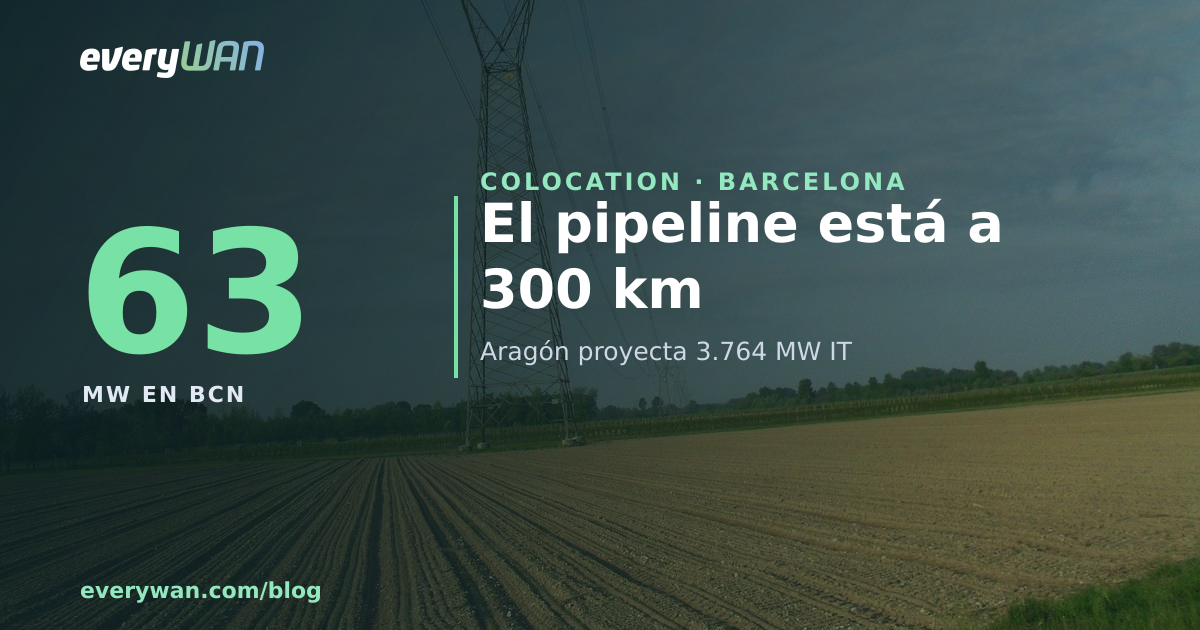
Inside the same report there are two figures that actually decide things, and neither made the headlines. First: Barcelona brought 21 MW IT into service over these six months, from 42 to 63. Second: the Aragón pipeline rose from 3,461 to 3,764 MW IT. And a third is worth adding, which is not in this instalment but in the previous one of the same report, covering October 2025 to March 2026: there Barcelona's book of announced projects stands at 525 MW IT, up from 244. Meaning Barcelona is neither abandoned nor barren: it has announced eight times what it has live. The point is that Aragón's figure is seven times Barcelona's, and it sits some three hundred kilometres away. That distance is not a logistical inconvenience: it is a physical constraint on what your recovery plan can promise.
What the report says, unadorned
The peninsula closed September with around 450 MW IT live, after adding 65 MW in the half-year. The split is what matters:
The two markets missing for the sum to add up: the rest of Spain goes from 35 to 42 MW IT and Lisbon stays at 25. Two hundred and twelve plus sixty-three plus one hundred and eight plus forty-two plus twenty-five adds up to the 450 in the headline.
The word pipeline deserves to be read with suspicion. An announced project is not a built room, just as a grid access permit is not a plug: we did that arithmetic in 6,329 MW granted and none in service. The 3,764 Aragonese megawatts are an intention; the 108 MW live are what exists today. But even treating the pipeline as what it is — a bet — the direction is unambiguous, and that direction is what matters for what follows.
The number nobody put in a headline: 14%
The same report publishes operational availability, which is the figure that actually answers "do I fit?". In colocation: 19% in Madrid and 14% in Barcelona. In hyperscale and neocloud capacity: 9% in Madrid and 0% in Barcelona.
That 14% needs careful reading, and here we show our working along with its catch: it is availability within the colocation market, which is only part of the 63 MW; the rest is hyperscale and self-build capacity, where availability is zero. So the only honest calculation is a ceiling: if all 63 MW were colocation, 14% would be 8.8 MW free. Since they are not, there is less. Even so, a company that needs a 5 kW rack is asking for under 0.1% of that ceiling. Put that way, the conclusion is awkward for anyone selling colocation, and we sell colocation: you do not have a capacity problem in Barcelona today. If someone is rushing you because "there is no space left", the report says otherwise for your size. What is gone is space for whoever asks for twenty megawatts at once, and that is not you.
Barcelona's 0% for hyperscalers is the same sentence read from the other end. Whoever needs tens of megawatts no longer looks for them here; they look where there is land and a grid connection. That is why the bulk of the pipeline is in Aragón and not on the Besòs, even though announcements keep coming on the Besòs too.
Three thousand seven hundred and sixty-four megawatts, three hours away by car
The projects fattening that figure have names and addresses: Day One and Ignis in Escatrón, up to 207 MW IT; Krolmap in Zaragoza, 103 MW IT; Merlin Edged Zaragoza-Wind in Botorrita, 144 MW IT in phase one alone. Look at the map before the megawatt: Escatrón is around 250 km from Barcelona by road and Botorrita around 330. "Three hundred kilometres" is the order of magnitude, not a constant: check it with your own two addresses. Added to the rest, Aragón is projecting almost sixty times the capacity Barcelona has live today and seven times the 525 MW IT Barcelona had announced in the previous instalment of the report.
If your recovery plan has been saying "second data centre" for years without specifying which one, this is the first time the map gives you a concrete and unpleasant answer: the cheap, new, power-rich second site is going to be far away. And distance carries a price that appears in no quotation.
The maths you can do before calling anyone
Light in single-mode fibre does not travel at 300,000 km/s but at around 204,000 km/s, because the core refractive index is about 1.47. That is 4.9 microseconds per kilometre one way, or roughly 9.8 microseconds per kilometre round trip. Rule of thumb: 1 millisecond of RTT per 100 km of fibre. It is not negotiable with any salesperson and it does not improve with budget.
The third column is the painful one and it is simple division: if a write cannot be acknowledged until the other room answers, and each round trip costs 2.9 ms, that thread tops out at about 340 acknowledgements per second. It does not matter which disks you bought. A data centre NVMe answers in tens of microseconds; 2.9 ms is two orders of magnitude more. At 300 km, the link stops being transport and becomes the disk.
Two honest caveats about that table. One: these are physical floors, not measurements. Fibre does not run in straight lines — the real route is typically 30% to 50% longer than the map distance — and every active device in between adds its own share. Two: the number that actually decides is not the millisecond but how many chained writes your application performs. A system that batches and parallelises lives fine with 3 ms; one that acknowledges transaction by transaction does not. Measure with your two actual postal addresses before promising anything.
What this decides about your plan
The map forces you into one of two branches, and the choice belongs to this year even if the contract belongs to 2028.
- If your RPO is zero — you cannot afford to lose a single transaction — your second site is metropolitan. Full stop. That means working within the colocation margin left in Barcelona, in a market where hyperscale-grade capacity sits at 0% availability. There is room for you; what is not growing at your pace is the supply that suits you.
- If your RPO tolerates minutes, Aragón and its 3,764 projected MW are perfectly valid. That they also end up cheaper per kW is a bet of ours and we have no figure to back it. What is certain: then stop calling it high availability. It is disaster recovery, and the difference is written in what you lose on the bad day.
The mistake we see most is not picking the wrong branch: it is picking the second on price and carrying on promising the first in the board meeting. The physics was settled the day the postal address was signed, and nobody finds out until the drill — or the incident. And it is worth remembering that separating is not, by itself, isolating: there are ways of losing both rooms at once that have nothing to do with kilometres, as we described in the backups were deleted at both data centres at once.
When this report changes nothing for you
If you have one rack, your agreed RTO is twenty-four hours, and your backups live outside the building and are genuinely restored from time to time, none of the above is urgent. The megawatt market does not move your renewal. What does move it is power per rack and the wording of the clause, which is a different conversation and we had it in colocation is no longer negotiated in U, but in kW. Reading a market report and rushing off to sign a second room is the expensive way to solve a problem you may not have.
What we do, and what we do not claim
We run Proxmox VE with Ceph storage in production spread across several data centres, we are an operator running our own network — BGP, transit and a public looking glass — and we provide colocation with our own hardware. Which means this kilometre arithmetic is not theoretical for us: it is what shapes how we spread replicas in distributed storage and what can honestly be promised in a disaster recovery plan. It also means we have a conflict of interest in saying "you probably do not need a second room yet", and we are saying it anyway.
What we do not claim: not a single price per kW in any market, because we have neither published nor verified them; nor that any specific operator does or does not have space for you, because that is asked and measured, not inferred from an aggregate report; nor any measured latency between two sites, because the table above is a calculated physical floor, not a measurement of ours. And we treat the Aragonese pipeline as what it is: a published intention, not a built room.
Sources (checked 17 Oct 2026): the figures from the Data Centers Iberian Region Snapshot by Colliers for April-September 2026 — around 450 MW IT live in the peninsula after adding 65 MW, Madrid from 175 to 212 MW IT (+21%), Barcelona from 42 to 63 MW IT (+50%), Aragón with 108 MW IT live and a pipeline of 3,764 MW IT against the previous 3,461, the facilities cited (Equinix MD5, NxN, Merlin Edged Getafe, Data4 Alcobendas, Digital Realty BCN1, the Templus expansion, Day One and Ignis in Escatrón, Krolmap, Merlin Edged Zaragoza-Wind), the rest of Spain from 35 to 42 MW IT, Lisbon at 25 MW IT, and operational availability of 19% in Madrid and 14% in Barcelona within the colocation market, 9% and 0% for hyperscalers — come from coverage of the report in EjePrime and Energías Renovables (8 Oct 2026), cross-checked against Data Center Market (8 Oct 2026). The figure for Barcelona's book of announced projects, 525 MW IT up from 244, does NOT belong to this instalment but to the previous edition of the same report (October 2025 - March 2026), and is cited as such in the body. Ours, and we label it as such: the 8.8 MW ceiling calculation (14% of 63 if all 63 were colocation, which they are not), the comparison of the Aragonese pipeline against Barcelona's live capacity, the latency budget and its table — derived from the speed of light in single-mode fibre with a refractive index of ~1.47 —, the ceiling on serialised writes, the reading of the 0% hyperscale figure, the two decision branches and the section on when this is not urgent.
How many kilometres are there between your two rooms?
If the answer is "I do not know" or "the second one does not exist yet", that is the conversation. We house our own and our clients' hardware in colocation, we design what can honestly be promised in disaster recovery, and we spread replicas across Ceph distributed storage knowing what every kilometre costs.
Talk to everyWAN

 Microsoft 365
 ES
ES  CAT
CAT  EN
EN